

Abstract
Endogenous amylin (islet amyloid polypeptide) is a 37-amino acid peptide co-secreted with insulin from pancreatic $beta$-cells. It serves as a profound neuroendocrine signal regulating nutrient assimilation and gastric motility. However, native amylin suffers from extreme self-aggregation (fibrillation) and rapid enzymatic clearance, severely limiting its utility in advanced laboratory experimentation. Cagrilintide is a rationally engineered, long-acting synthetic amylin analogue featuring strategic amino acid substitutions and a sophisticated fatty diacid moiety. In vitro cellular assays utilizing cloned human receptor models reveal that Cagrilintide operates via incredibly complex heterodimeric receptor dynamics, necessitating the co-expression of the Calcitonin Receptor (CTR) and Receptor Activity-Modifying Proteins (RAMPs). This comprehensive review dissects the receptor-level mechanics of Cagrilintide and its profound in vitro synergistic potential when co-administered with GLP-1 analogues.
1. Introduction: The Need for Amylin Analogues
Postprandial (post-meal) metabolic homeostasis is governed by a symphony of peptides. While insulin primarily drives glucose into cells, amylin operates upstream to control the rate at which nutrients enter the bloodstream. It centrally mediates satiety signals in the hindbrain (Area Postrema) and peripherally acts on the vagus nerve to drastically slow gastric emptying.
Theoretical in vitro applications of native human amylin are severely hindered by its intrinsic biophysical instability; it rapidly misfolds into insoluble amyloid fibrils.
Cagrilintide was engineered to overcome these hurdles. By introducing strategic proline substitutions, fibril formation is completely abolished. Furthermore, to combat rapid in vivo plasma clearance, chemists attached a $C_{20}$ fatty diacid via a specialized linker. While this lipid chain is primarily designed to securely bind human serum albumin ($t_{1/2} = 171$ hours) for in vivo longevity, in vitro receptor binding assays must carefully account for this massive hydrophobic appendage when calculating intrinsic binding affinities.
2. Intricate Receptor Mechanics: The Heterodimeric Constraint
The most fascinating aspect of amylin pharmacology lies in the unique architecture of its receptor. The “Amylin Receptor” is not a single, standalone protein. It is an obligate heterodimer consisting of two distinct, necessary components:
2.1 The Core: Calcitonin Receptor (CTR)
The foundation of the receptor complex is the Calcitonin Receptor, a classic Class B G-Protein Coupled Receptor (GPCR). In isolation (when expressed solely on a cell membrane in vitro without accessory proteins), the CTR possesses a very high affinity for the hormone calcitonin, but a remarkably low affinity for amylin or cagrilintide.
2.2 The Modifier: RAMPs (Receptor Activity-Modifying Proteins)
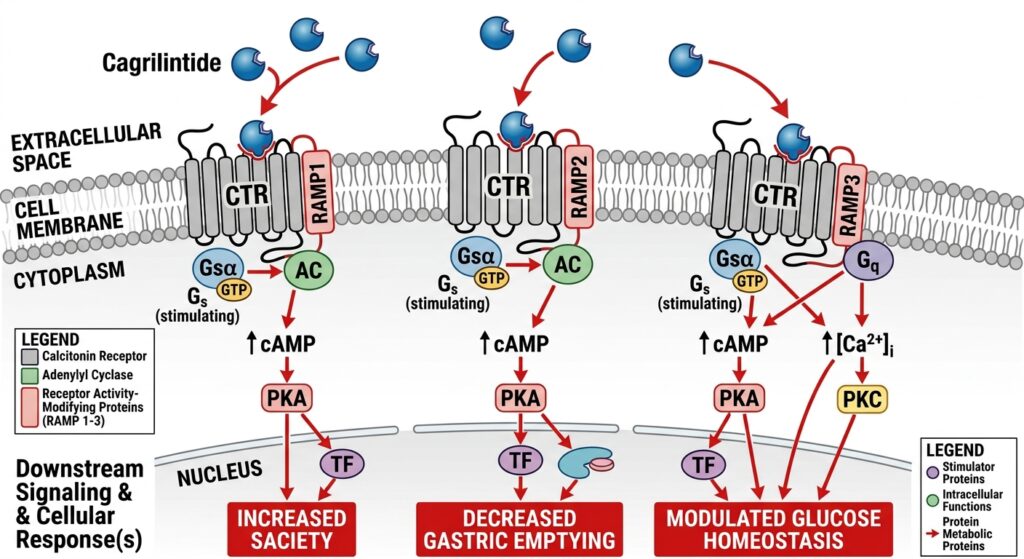
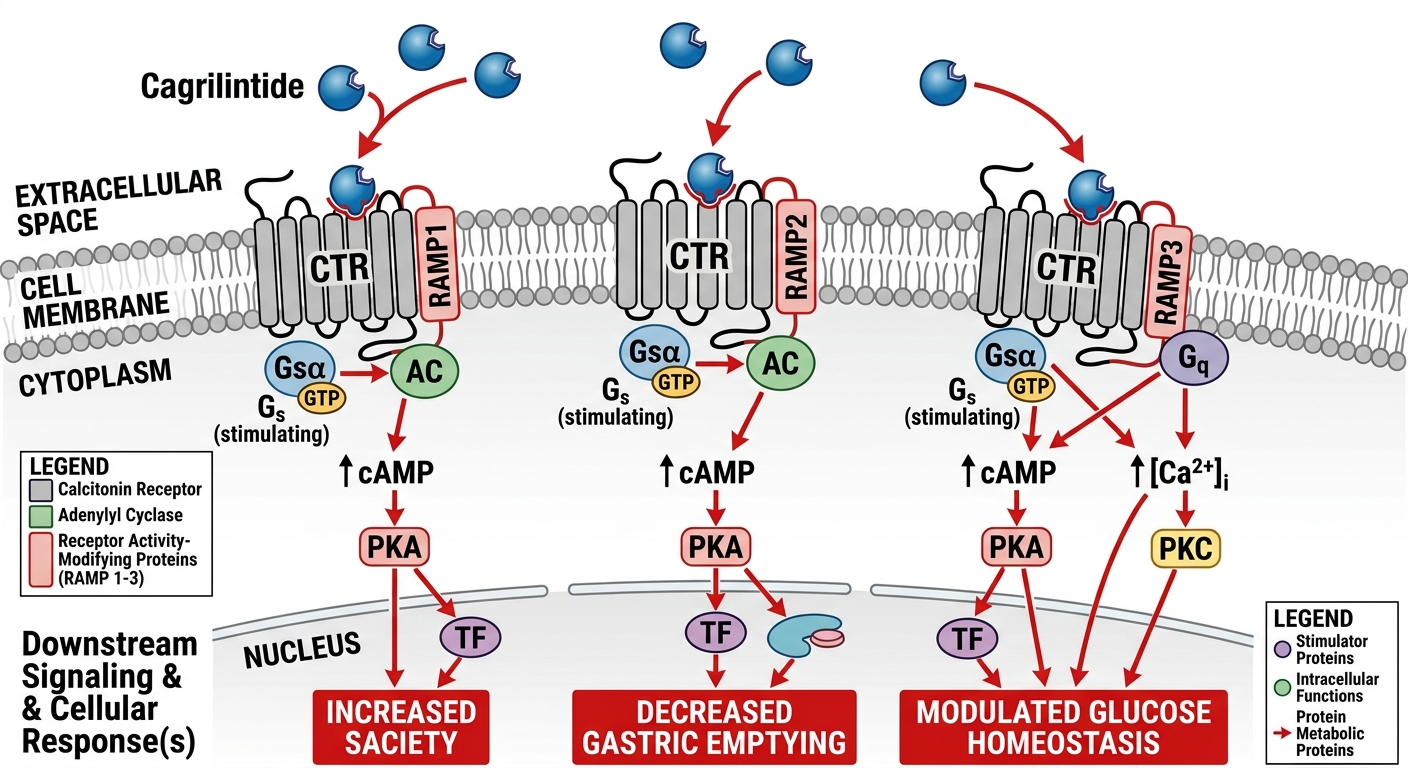
To transition a CTR into a functional Amylin Receptor, a second, single-transmembrane protein class is required: the Receptor Activity-Modifying Proteins (RAMPs). There are three distinct RAMPs (RAMP1, RAMP2, RAMP3).
When a RAMP physically associates with the CTR on the cell surface, it forces a profound conformational shift in the extracellular binding domain of the core receptor. This structural alteration drastically alters the receptor’s pharmacological profile.
It generates three distinct Amylin Receptor subtypes:
* CTR + RAMP1 = $AMY_1$ Receptor
* CTR + RAMP2 = $AMY_2$ Receptor
* CTR + RAMP3 = $AMY_3$ Receptor
In rigorous in vitro competitive binding assays utilizing radiolabeled or fluorescently tagged Cagrilintide on dual-transfected cell lines, researchers confirm that Cagrilintide is a powerful, non-selective Dual Amylin and Calcitonin Receptor Agonist (DACRA). It binds with high affinity to the naked CTR and to all three variations of the RAMP-modified $AMY_1, AMY_2,$ and $AMY_3$ receptor complexes.
3. Intracellular Transduction: The $G_{alpha s}$ Pathway
Upon successfully docking to the extracellular face of the AMY or CTR complexes, Cagrilintide initiates a classic GPCR signaling cascade common to the secretin/glucagon receptor family.
The activated receptor complex recruits and activates an intracellular heterotrimeric stimulatory G-protein ($G_s$). The freed $G_{alpha s}$ subunit translocates and binds to Adenylyl Cyclase, upregulating the conversion of ATP into cyclic AMP (cAMP).
In vitro, this rapid accumulation of cAMP is the primary measurable readout of Cagrilintide activity. The resulting cAMP wave activates Protein Kinase A (PKA), which subsequently mediates the downstream physiological effects—primarily neuronal firing alterations indicating satiety in hindbrain models, or smooth muscle relaxation leading to suppressed contractility in gastric wall assays.
4. The Rationale for Synergy: GLP-1 and Amylin Co-Agonism
Perhaps the most significant aspect of Cagrilintide’s utility lies in its capacity for synergistic co-administration. Modern neuroendocrine research is heavily focused on the additive physiological effects of combining an Amylin analogue (Cagrilintide) with a Glucagon-Like Peptide 1 (GLP-1) analogue (like Semaglutide), a combination clinically dubbed CagriSema.
4.1 Distinct but Convergent Pathways
In vitro models utilize primary neuronal cultures (such as isolated nodose ganglion neurons or slice preparations from the Area Postrema/NTS) to map these converging signals.
GLP-1 Receptors (GLP-1R) and Amylin Receptors are localized across distinct, sometimes overlapping, but ultimately separate neuronal populations within the central and peripheral nervous systems.
While both Cagrilintide acting on the AMY receptor and Semaglutide acting on the GLP-1R ultimately elevate intracellular cAMP to trigger satiety and metabolic adjustments, they arrive at that endpoint via completely distinct receptor portals. Because these peptides do not compete for the exact same extracellular binding pocket, researchers observe profound, true synergy in vitro when the compounds are co-administered. The combined cAMP generation and subsequent neuronal depolarization far exceed the maximal output achievable by either peptide administered alone at saturating concentrations.
5. Conclusion
Cagrilintide represents a triumph of rational peptide engineering over nature’s structural limitations. By stabilizing the primary amylin sequence against chaotic fibril formation, it provides an indispensable tool for mapping the highly complex, RAMP-dependent heterodimeric machinery of the Calcitonin/Amylin receptor family in controlled cellular environments. Furthermore, in vitro evidence robustly supports the potent biochemical rationale for its current status at the forefront of metabolic research: when combined with GLP-1 analogues, Cagrilintide orchestrates an additive, multi-pathway signaling convergence that profoundly amplifies the physiological mechanisms regulating satiety and gastric flow.
Scientific References & Further Reading:
- Mietzner, R., et al. (2023). Cagrilintide, a Long-Acting Amylin Analogue, and Its Action at Human Calcitonin and Amylin Receptors. Journal of Medicinal Chemistry, 66(5), 3465–3479.
- Lau, D.C.W., et al. (2021). Once-weekly cagrilintide for weight management in people with overweight and obesity: a randomized, double-blind, placebo-controlled, dose-finding phase 2 trial. The Lancet, 397(10290), 1736–1748.
- Knudsen, L.B., et al. (2022). Dual hormone co-agonists for treatment of obesity. Trends in Molecular Medicine, 28(4), 300–314.
- Hay, D. L., et al. (2018). Amylin: Pharmacology, Physiology, and Clinical Potential. Pharmacological Reviews, 70(2), 344-386.
(Disclaimer: The content detailed above is intended strictly for in vitro laboratory research and academic reference. Synthetic peptides discussed herein are not approved, designed, or strictly evaluated for human consumption, diagnostics, or therapeutic interventions.)