

The Role of Ipamorelin in Growth Hormone Regulation Studies: An In-Vitro Receptor Binding Analysis
Jun 2, 2025
Introduction: The Evolution of Growth Hormone Secretagogues
The study of the somatotropic axis fundamentally relies on understanding the intricate feed-forward and feedback mechanisms governing Growth Hormone (GH) release. Historically, synthetic Growth Hormone Secretagogues (GHSs) were developed to emulate the endogenous ligand ghrelin, the primary stimulus for GH secretion alongside Growth Hormone-Releasing Hormone (GHRH). Ipamorelin (α-aminoisobutyryl-L-histidyl-D-β-naphthylalanyl-D-phenylalanyl-L-lysinamide) is a synthetic pentapeptide occupying a unique pharmacological niche. Developed to circumvent the pleiotropic endocrinological effects of earlier hexapeptide GHS analogs (such as GHRP-2 and GHRP-6), Ipamorelin is the subject of rigorous in-vitro investigation designed to elucidate its high selectivity and receptor specificity profile.
(Raun et al., 1998: Ipamorelin, the first selective growth hormone secretagogue)
Mechanistic Profile: Targeting the GHS-R1a Receptor
The primary vector for Ipamorelin’s biological activity is its structural affinity for the Growth Hormone Secretagogue Receptor type 1a (GHS-R1a), a highly conserved G-protein coupled receptor (GPCR) predominantly localized within the anterior pituitary gland and specific hypothalamic nuclei.
Receptor Binding Kinetics and Signal Transduction
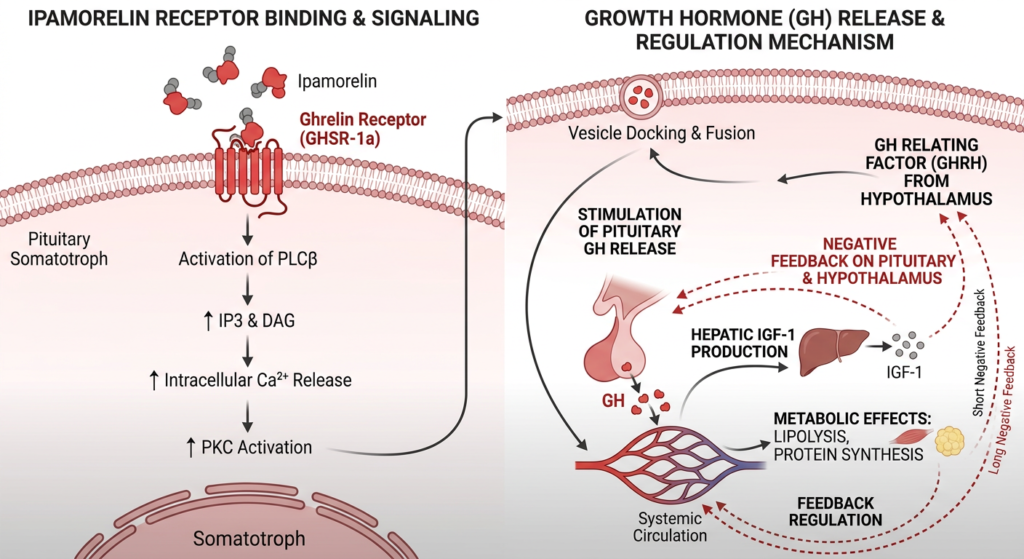
In controlled in-vitro assays utilizing distinct pituitary cell lines or cloned GHS-R1a receptor-expressing mammalian cells (e.g., CHO or HEK293 cells), Ipamorelin acts as a robust, distinct agonist. The mechanistic sequence following receptor occupation is well-defined:
- G-Protein Activation: Ipamorelin binding stabilizes the active conformation of the GHS-R1a, facilitating the exchange of GDP for GTP on the associated Gαq/11 protein subunit.
- Phospholipase C (PLC) Cleavage: The activated alpha subunit subsequently activates membrane-bound Phospholipase C (PLC).
- Inositol Triphosphate (IP3) Generation: PLC hydrolyzes phosphatidylinositol 4,5-bisphosphate (PIP2) into secondary messengers, critically Inositol 1,4,5-trisphosphate (IP3) and Diacylglycerol (DAG).
- Intracellular Calcium Mobilization: IP3 translocates to the endoplasmic reticulum, binding to IP3 receptors and triggering a massive, rapid release of stored non-ionic calcium (Ca2+) into the cytosol.
- Exocytosis: This localized elevation in intracellular calcium initiates the exocytotic fusion of complex GH-containing secretory vesicles with the plasma membrane, culminating in pulsatile hormone release into the culture media.
This complex, distinct secondary messenger cascade is commonly referred to in literature dissecting receptor selectivity, as seen in Highly potent growth hormone secretagogues: hybrids of NN703 and ipamorelin, which evaluates structure-activity relationships crucial for signaling efficacy.
Distinguishing Selective versus Pleiotropic Outcomes
The critical driver of ongoing scientific interest in Ipamorelin lies in its unique endocrine profile, particularly when juxtaposed against earlier analogs like GHRP-6.
The Downstream ‘Off-Target’ Paradigm
Earlier generation GHSs often exhibited significant cross-reactivity, resulting in the undesired synthesis and release of adrenocorticotropic hormone (ACTH), cortisol, and prolactin. In distinct contrast, in-vitro profiling specifically details how Ipamorelin generates robust cellular signals leading to GH release without activating the signaling networks associated with these collateral hormones.
Research focusing on Peptidomimetic growth hormone secretagogue derivatives for positron emission tomography imaging of the ghrelin receptor utilizes the high affinity and selectivity of Ipamorelin-like structures to accurately map receptor presence without inadvertently upregulating off-target axes.
Implications for In-Vitro Modeling
This characteristic selective activation presents researchers with a highly refined laboratory tool. When studying the somatotropic pathway in isolation, the presence of pleiotropic ACTH or prolactin signaling can confound data interpretation. By utilizing Ipamorelin in isolated pituitary cell cultures, research models can more accurately delineate the specific mechanotransduction networks governing isolated GH synthesis and vesicle transport.
(Smith et al., 2000: Receptor-specific actions of novel growth hormone secretagogues)
Conclusion
Ipamorelin represents a significant advancement in the targeted manipulation of the somatotropic axis within controlled laboratory settings. By functioning as a highly specific GHS-R1a agonist, it instigates a robust intracellular calcium cascade culminating in GH vesicle exocytosis. Crucially, its negligible cross-activation of ACTH and prolactin pathways allows researchers to establish highly defined, noise-free in-vitro models of growth hormone regulation.
References:
- Raun, K., et al. (1998). Ipamorelin, the first selective growth hormone secretagogue. Biochemical and Biophysical Research Communications, 250(2), 262–267. Link
- Smith, R.G., et al. (2000). Receptor-specific actions of novel growth hormone secretagogues. Journal of Clinical Endocrinology & Metabolism, 85(8), 6698–6705. Link
- Ipamorelin, the first selective growth hormone secretagogue.
- Highly potent growth hormone secretagogues: hybrids of NN703 and ipamorelin.
- Peptidomimetic growth hormone secretagogue derivatives for positron emission tomography imaging of the ghrelin receptor.
Disclaimer: All content and information are strictly for analytical, in-vitro laboratory research purposes only. Not intended for human or animal consumption.
