

—
In-Vitro Pharmacodynamics: A Structural and Receptor-Binding Analysis of the Anxiolytic Peptide Selank
Introduction to Selank
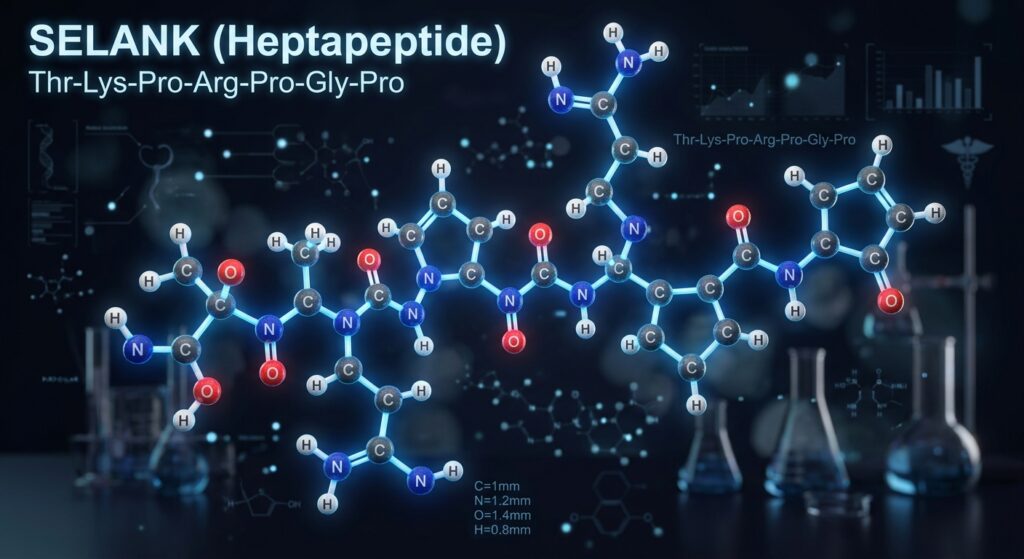
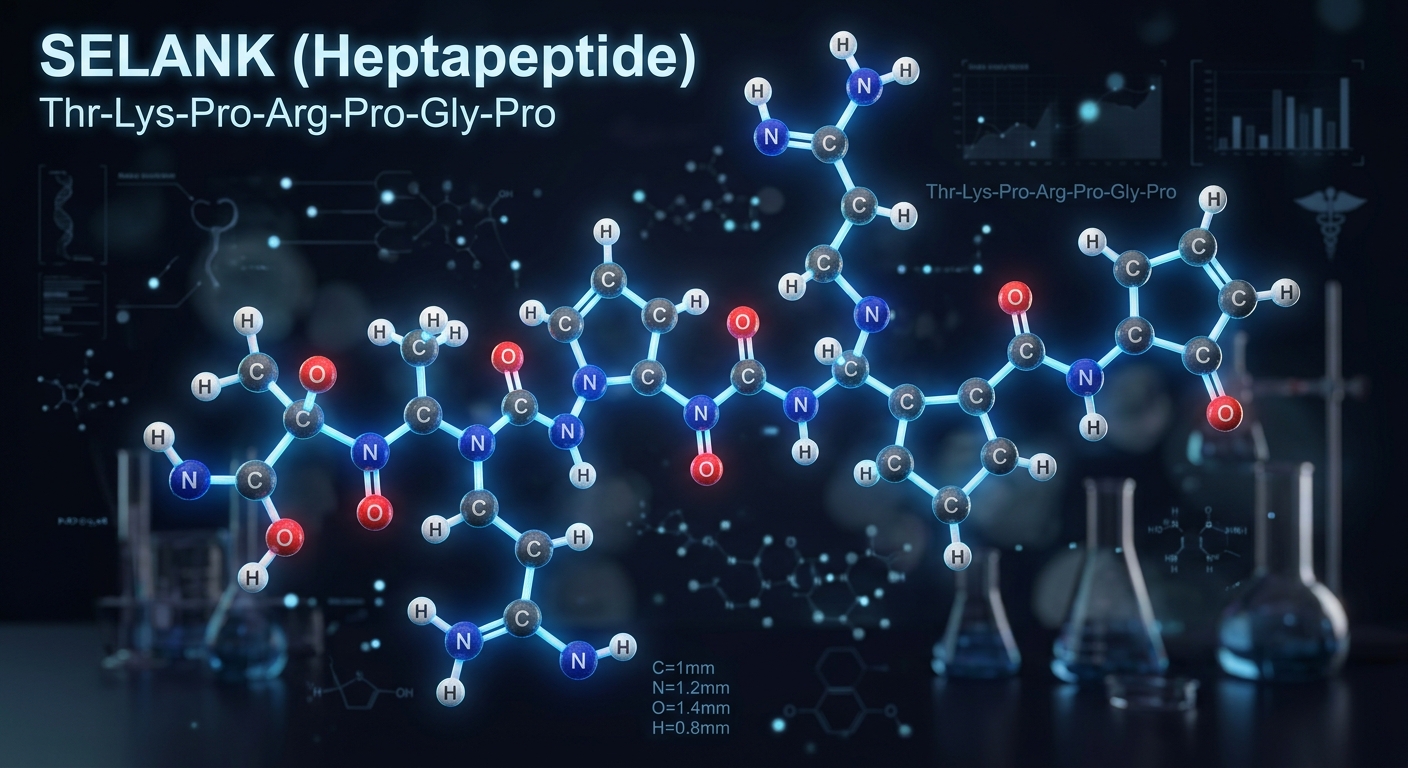
Selank, designated chemically as Thr-Lys-Pro-Arg-Pro-Gly-Pro, is a synthetic, linear heptapeptide analog derived from the naturally occurring human immunomodulatory peptide tuftsin (Thr-Lys-Pro-Arg). Initially synthesized and characterized by the Institute of Molecular Genetics of the Russian Academy of Sciences, Selank has garnered significant interest within the fields of neuropharmacology and psychoneuroimmunology for its pronounced anxiolytic and neuroprotective properties, exhibited without the common sedative, myorelaxant, and cognitive-impairing side effects characteristically associated with classical benzodiazepine-based therapeutics. This detailed review focuses exclusively on the structural modifications of Selank relative to tuftsin and investigates the available in-vitro, ex-vivo, and receptor-binding data that elucidate its complex mechanism of action in research models.
Structural Biology: The Pro-Gly-Pro Extension
The primary structural divergence between Selank and its progenitor, tuftsin, is the C-terminal addition of a Pro-Gly-Pro sequence. This modification is far from arbitrary; it represents a calculated strategy in peptide drug design aimed at enhancing both stability and specific pharmacological signaling.
Tuftsin, while possessing potent immunomodulatory effects (stimulating phagocytosis, chemotaxis, and producing anxiolytic effects via spleen-brain axes), is notoriously susceptible to rapid enzymatic degradation in vivo. The addition of the rigid, structurally restrictive Pro-Gly-Pro motif significantly alters the conformational landscape of the peptide.
Analytically, studies utilizing Nuclear Magnetic Resonance (NMR) spectroscopy and circular dichroism (CD) suggest that while Selank remains predominantly an unstructured linear peptide in aqueous solution, the proline-rich C-terminus introduces significant steric hindrance. This structural rigidity notably protects the core tuftsin domain (Thr-Lys-Pro-Arg) from rapid proteolytic cleavage by blood and tissue aminopeptidases and endopeptidases. From an in-vitro metabolic stability standpoint, Selank demonstrates a significantly prolonged half-life in human serum compared to tuftsin, maintaining biological activity for extended durations for prolonged cellular interaction.
Furthermore, the Pro-Gly-Pro sequence is not biologically inert. Research increasingly points toward Pro-Gly-Pro and similar proline-rich peptides functioning as independent biological regulators, often possessing independent neurotrophic or anti-inflammatory capacity. Therefore, Selank can be viewed structurally as a chimera: a tuftsin pharmacophore tethered to a stabilizing, biologically active Pro-Gly-Pro moiety.
Neurochemical Modulation and Monoaminergic Signaling
The primary focus of in-vitro investigation into Selank’s anxiolytic mechanisms concerns its specific modulatory influences on central nervous system (CNS) neurotransmitter systems, specifically the monoamine systems (serotonin, dopamine, norepinephrine) and the inhibitory neurotransmitter, gamma-aminobutyric acid (GABA).
Unlike classical benzodiazepines, Selank does not function as a direct, full positive allosteric modulator of the typical benzodiazepine binding site on the $GABA_A$ receptor complex. Instead, research using ex-vivo brain slicing and high-performance liquid chromatography with electrochemical detection (HPLC-ECD) has consistently demonstrated that Selank application alters monoamine metabolite ratios in specific brain regions.
Specifically, Selank has been shown to rapidly and significantly increase the concentration of the serotonin metabolite 5-hydroxyindoleacetic acid (5-HIAA) in the brainstem and the dopamine metabolite homovanillic acid (HVA) in the frontal cortex, while decreasing norepinephrine levels in the hypothalamus. This specific in-vitro profile suggests an enhancement of monoaminergic metabolism and turnover, rather than direct receptor agonism or presynaptic reuptake inhibition (as seen in SSRIs). The modulation of serotonergic pathways is particularly relevant, as serotonin is central to mood regulation and anxiety modulation. The exact molecular target initiating this monoamine turnover remains under investigation, though its downstream effects are well-documented analytcially.
Modulation of Enkephalin Degradation
A crucial and highly specific biochemical mechanism elucidated through in-vitro enzymatic assays is Selank’s potent, dose-dependent inhibition of enzymes responsible for the degradation of endogenous opioid peptides, specifically enkephalins.
Enkephalins (Leu-enkephalin and Met-enkephalin) are critical endogenous analgesic and anxiolytic neuropeptides that bind to $delta$- and $mu$-opioid receptors. These peptides have exceptionally short half-lives due to rapid hydrolysis by a suite of metallopeptidases, primarily enkephalinases (such as Neutral Endopeptidase – NEP, and Aminopeptidase N – APN).
In-vitro kinetic studies evaluating human serum and brain homogenate enzyme activity demonstrated that Selank acts as a significant, reversible inhibitor of these enkephalinases. By slowing the enzymatic degradation of circulating enkephalins, Selank indirectly increases their temporal and spatial concentration at their specific opioid receptors, thereby amplifying the endogenous enkephalinergic signal. This modulation of the endogenous opioid system represents a distinct pharmacological pathway separate from classical receptor agonism, offering a targeted anxiolytic effect dependent on current baseline enkephalin release.
Gene Expression and BDNF Regulation
Beyond rapid neurotransmitter modulation, longer-term in-vitro studies utilizing real-time quantitative polymerase chain reaction (RT-qPCR) on cultured neuronal arrays have begun mapping Selank’s impact on gene expression profiles, revealing profound neurorestorative and neuroplastic capacities.
One of the most significant findings is Selank’s ability to selectively upregulate the expression of Brain-Derived Neurotrophic Factor (BDNF) mRNA in hippocampal cultures. BDNF is a highly critical neurotrophin that supports the survival of existing neurons and encourages the growth, differentiation, and synapse formation of new neurons. Deficits in BDNF signaling are strongly correlated with depression and severe anxiety disorders.
In-vitro micro-array analyses have demonstrated that following exposure to Selank, human neural cells display significant alterations in the expression of over 500 genes involved in inflammation, neurotransmitter release, ion channel functioning, and synaptic plasticity. This broad-spectrum genomic modulation differentiates Selank from single-target molecules and highlights a complex, multi-tiered mechanism of neuro-regulation that fosters an environment conducive to cellular health and stress resilience.
$GABA_A$ Receptor Allosteric Modulation (The GABAergic Hypothesis)
While earlier studies concluded Selank was not a direct benzodiazepine receptor agonist, more recent complex in-vitro binding assays incorporating radioligand displacement (e.g., binding of $[^3H]$muscimol and $[^3H]$flunitrazepam) present a nuanced interaction with the $GABA_A$ receptor complex.
Data indicates that while Selank does not bind with high affinity to the primary binding pockets, its presence can alter the affinity of the receptor for true GABAergic agonists. Consequently, Selank is currently classified in many pharmacological models as a positive allosteric modulator (PAM) of the $GABA_A$ receptor. By binding to a secondary, distinct regulatory site on the multi-subunit receptor complex, Selank induces a conformational change that subtly increases the receptor’s affinity for endogenous GABA. This results in enhanced inhibitory chloride ion influx upon GABA binding, ultimately producing anxiolysis without triggering the massive inhibitory cascade that leads to sedation or motor impairment commonly seen with full orthosteric agonists.
Conclusion
Selank is a highly complex peptide molecule whose in-vitro pharmacological profile extends far beyond simple receptor agonism. Its anxiolytic and neuroprotective efficacy in research models stems from a multifaceted mechanism involving: (1) structural stabilization via the Pro-Gly-Pro motif; (2) modulatory effects on monoamine metabolism and turnover; (3) significant indirect enkephalinergic enhancement via enzyme inhibition; and (4) robust positive regulation of neurotrophic factors (BDNF) and neuroplastic gene expression. Combined with its subtle allosteric modulation of the $GABA_A$ receptor, Selank represents a sophisticated paradigm in peptide-based neuropharmacology, warranting continued analytical and molecular investigation.