

—
In-Vitro vs In-Vivo: Methodologies in Preclinical Peptide Research
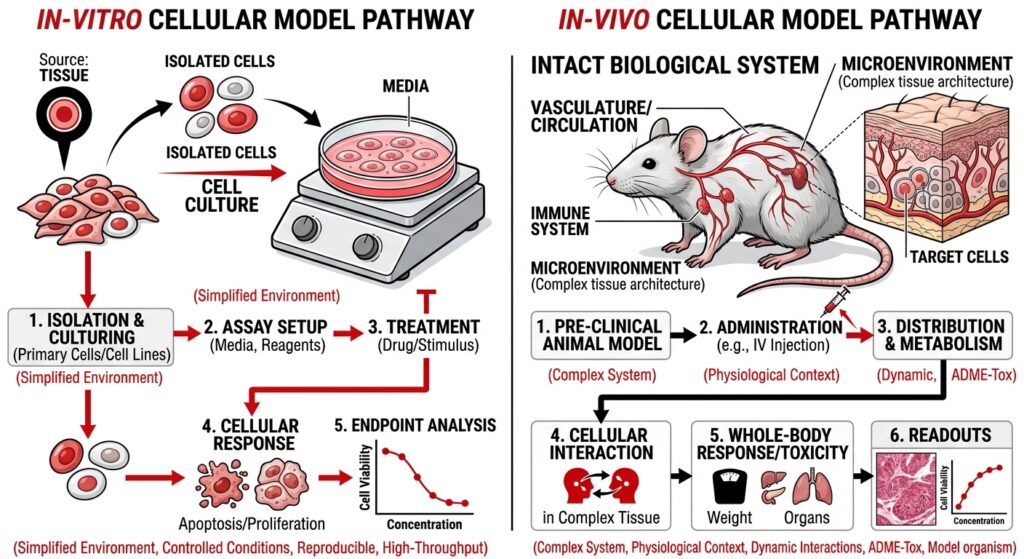
In the structured progression of pharmacological and biochemical research, delineating the exact boundaries and capabilities of experimental models is paramount. The initial phases of peptide characterization rely intrinsically on in-vitro (Latin for “in glass”) models, utilizing controlled environments outside a living organism. These studies provide foundational datasets regarding cellular pathways, receptor affinities, and basic biochemical interactions before progressing to the highly complex, systemic environments defining in-vivo (Latin for “within the living”) models.

Defining the In-Vitro Environment
In-vitro methodologies encompass testing conducted within localized instruments such as Petri dishes, test tubes, and microtiter plates. In biomedical research, this definition extends predominantly to cell culture models, utilizing specific primary cells or immortalized cell lines suspended in carefully calibrated growth media.
Methodological Advantages of Experimental Isolation
The primary utility of in-vitro assays is parameter isolation. By removing the subject peptide from the immense variability of a living biological system (metabolic degradation by liver enzymes, renal clearance, complex immune responses, etc.), researchers can observe fundamental interactions with molecular clarity.
- Receptor Binding Kinetics: Radioligand binding assays performed on cell membranes provide precise quantifiable data on a peptide’s affinity (Kd) for specific cellular receptors. Without the interference of endogenous circulating hormones, exactly how tightly a synthesized analog binds can be determined.
- Signal Transduction Mapping: Once bound, tracking the intracellular cascade—such as tracking cAMP elevation for GPCRs or phosphorylation events utilizing Western Blots—is achievable.
- Controlled Dosing Gradients: Researchers can administer exact, stable concentrations of a peptide directly to target tissues to establish meticulous minimal effective concentrations and establish sigmoidal dose-response curves.
For a deeper understanding of bridging 2D cell cultures to more complex physiological interpretations, see foundational reviews in Nature Reviews Molecular Cell Biology: The third dimension bridges the gap between cell culture and live tissue.
The Transition to In-Vivo Complexity
In-vivo research involves testing within a whole, living organism (typically murine models in preclinical phases). This introduces the pharmacodynamic and pharmacokinetic realities absent in isolated cell cultures.
Assessing Bioavailability and Pharmacokinetics (PK)
A peptide may exhibit extraordinary receptor affinity in-vitro, yet fail in-vivo. In-vivo models test the “ADME” parameters:
* Absorption: How much of the peptide enters circulation past mucosal barriers or tissue depots.
* Distribution: Once circulating, whether the peptide can physically penetrate target tissues or cross the Blood-Brain Barrier (BBB).
* Metabolism: The rate at which systemic enzymes (like serum peptidases) degrade the molecular structure.
* Excretion: The half-life of the compound before it is filtered by renal or hepatic systems.
Assessing Systemic Pharmacodynamics (PD) and Redundancy
Living organisms possess complex homeostatic mechanisms. An in-vitro assay demonstrating a peptide causing rapid cell signaling may yield no net effect in-vivo due to biological redundancy—where secondary systems counteract the initial stimulus to maintain homeostasis.
As highlighted in the journal PLoS Medicine, recognizing the limitations when transitioning between isolated testing and whole-system results is vital to interpreting preclinical data: Can animal models of disease reliably inform human studies?.
Integrating Both Models in Peptide Characterization
Modern peptide research absolutely requires both stages. In-vitro studies act as the essential high-throughput screening filter to determine if a mechanism exists, while subsequent in-vivo work dictates how that mechanism operates within systemic physiological constraints. Assays involving cellular protection parameters, cell proliferation metrics, and gene expression changes must always be first isolated on the bench before their implications in a living organism are hypothesized.
Disclaimer: The content detailing In-Vitro and In-Vivo methodologies within this document is strictly for academic research and educational purposes. All data presented relates solely to laboratory investigations and experimental models. The peptides discussed in relation to these models are strictly for laboratory use and are not intended or approved for human consumption, medical intervention, or outside a controlled research environment.