

—
Analytical Methodologies: Principles and Applications of High-Performance Liquid Chromatography (HPLC) in Peptide Characterization
Introduction to the High-Performance Era of Separation Science
High-performance liquid chromatography (HPLC) stands as a cornerstone analytical technique within modern biochemical research, offering unparalleled resolution, sensitivity, and reproducibility in the separation, identification, and quantification of complex molecular mixtures. Originally conceptualized as high-pressure liquid chromatography due to the requisite operational pressures, the nomenclature evolved to emphasize the extreme performance fidelity achieved compared to classical column chromatography. For research involving synthetic peptides, therapeutic proteins, and complex natural product extracts, HPLC is not merely a tool but an indispensable prerequisite for ensuring molecular integrity and purity. This highly technical review dissects the foundational mechanics, instrumentation, thermodynamic principles, and specific in-vitro analytical applications of HPLC.
The Physical Chemistry of Separation: Thermodynamics and Kinetics
At its core, HPLC operates on the principles of continuous partition between two distinct phases: a dynamic mobile phase (liquid) and a stationary phase (solid or bonded phase). The separation mechanism is fundamentally governed by the differential thermodynamic affinities of individual analytes within a sample matrix for these two phases.
The retention of a solute ($t_R$) is defined by its partition coefficient ($K$), which represents the ratio of the analyte concentration in the stationary phase ($C_s$) to its concentration in the mobile phase ($C_m$): $K = C_s/C_m$. Differences in $K$ values among analytes translate to distinct migration velocities through the chromatographic bed. When analytes exhibit disparate molecular interactions—such as hydrophobic, dipole-dipole, ionic, or hydrogen-bonding interactions—with the stationary phase, they distribute differently.
The kinetic aspect of the separation, specifically the dispersion or band broadening of the analyte zone as it transits the column, is classically modeled by the van Deemter equation ($H = A + B/u + Cu$). This equation relates the height equivalent to a theoretical plate ($H$, a measure of column efficiency) to the linear velocity of the mobile phase ($u$).
* A Term (Eddy Diffusion): Relates to the multiple pathways analyte molecules can take through the packed bed. It is minimized by utilizing small, uniformly spherical particles.
* B Term (Longitudinal Diffusion): Describes the diffusion of analytes along the axis of the column, independent of flow. It becomes significant at very low flow rates.
* C Term (Resistance to Mass Transfer): Represents the finite time required for the analyte to equilibrate between the mobile and stationary phases. It increases linearly with flow rate.
The evolutionary shift from traditional LC to HPLC was predicated on the engineering feat of utilizing ultra-fine stationary phase particles (typically ranging from 1.7 $mu$m to 5 $mu$m in diameter). These minute particles significantly diminish the ‘A’ and ‘C’ terms of the van Deemter equation, maximizing column efficiency ($N$, the number of theoretical plates) and resulting in exceptionally sharp, narrow chromatographic peaks. However, this dense packing inherently creates substantial hydraulic resistance, necessitating high-pressure pumping systems to force the mobile phase through the column at practical flow rates.
Deconstructing HPLC Instrumentation
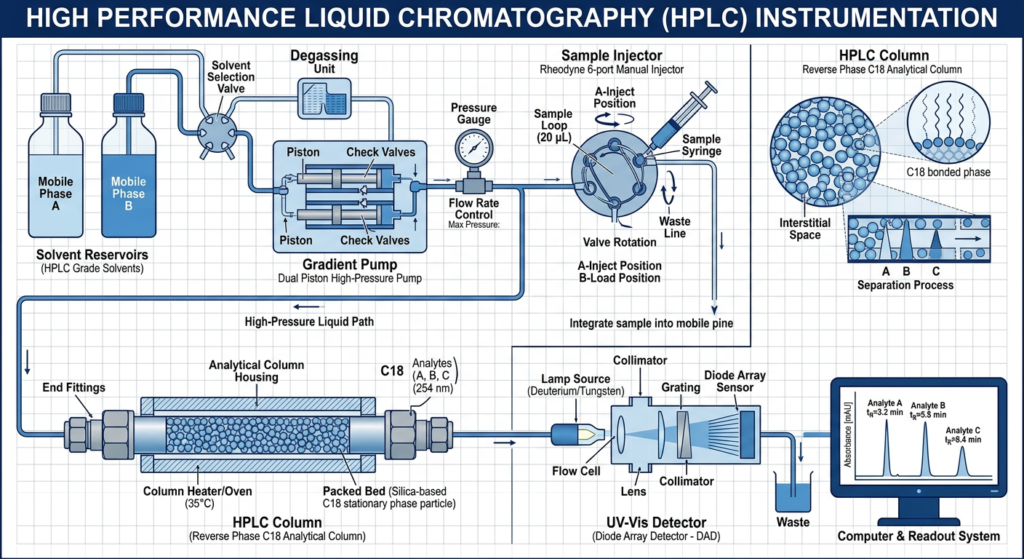
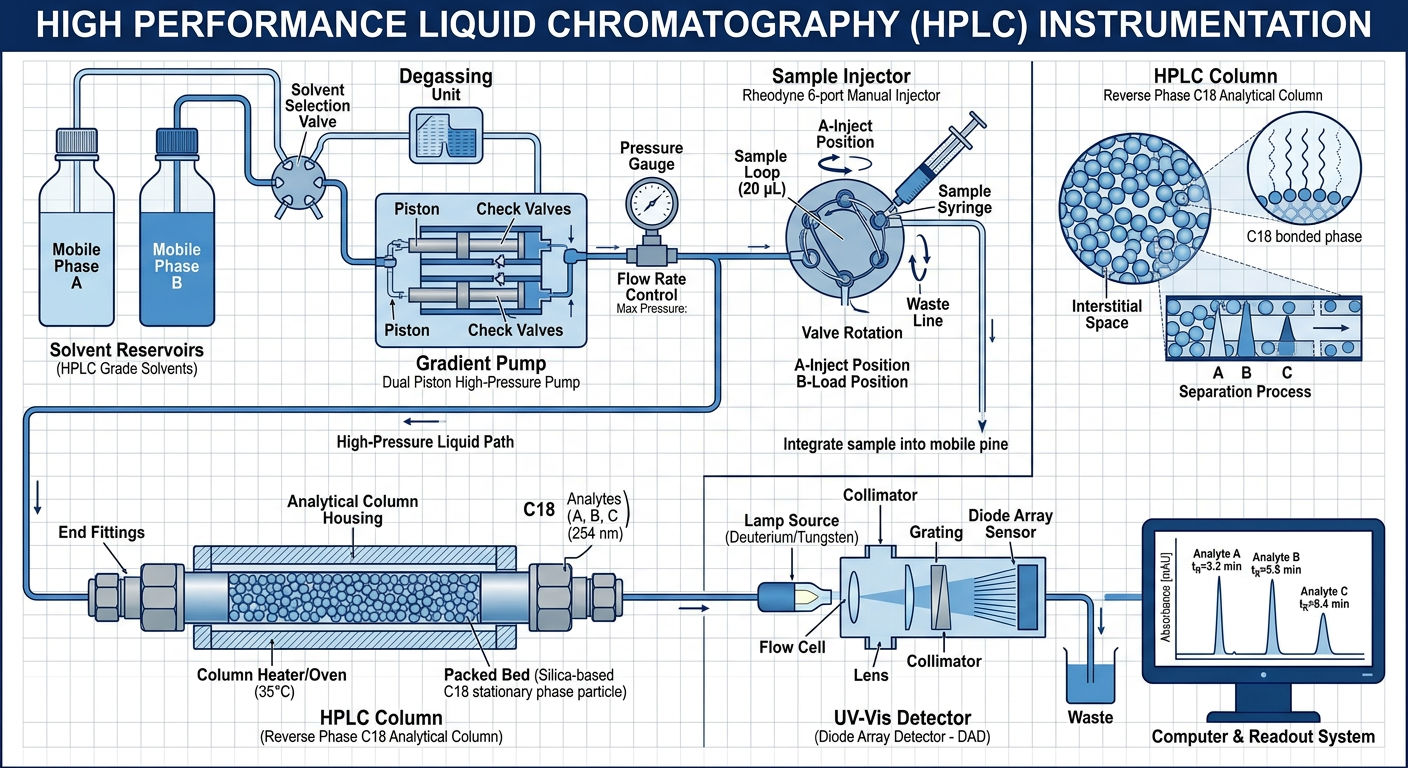
A modern analytical HPLC system is a marvel of precision engineering, comprised of several highly integrated modules designed for exact fluidic control and sensitive detection.
1. The Solvent Delivery System (Pumps)
The pump is responsible for driving the mobile phase through the system at a constant, highly reproducible flow rate (typically 0.1 to 2.0 mL/min for analytical columns) against pressures that can exceed 600 bar (or $>1000$ bar in Ultra-High-Performance Liquid Chromatography, UHPLC). Most systems employ dual-piston reciprocating pumps equipped with pulse dampeners. Complex separations often employ gradient elution, where the composition of the mobile phase—specifically the ratio of aqueous to organic solvents—is dynamically altered over time. This requires sophisticated binary or quaternary pumping systems capable of micro-liter precision in solvent blending, significantly enhancing peak capacity and reducing run times for complex mixtures.
2. The Sample Injector (Autosampler)
Introducing the sample into the high-pressure fluidic stream without depressurizing the system or introducing air bubbles requires precise micro-engineering. Modern autosamplers utilize a multi-port injection valve and sample loop mechanism. The sample is aspirated into a designated loop at ambient pressure, and upon injection, the valve rotates, diverting the high-pressure mobile phase stream through the loop, sweeping the sample quantitatively onto the column head. Injection volumes are meticulously controlled, often down to $0.1 mu$L.
3. The Chromatographic Column
The column is the heart of the HPLC system where the physical separation occurs. Typically constructed of high-grade stainless steel to withstand extreme pressures, analytical columns commonly have internal diameters of 2.1 to 4.6 mm and lengths of 50 to 250 mm. The stationary phase most frequently utilized in peptide analysis is reversed-phase (RP-HPLC). RP-HPLC employs a non-polar stationary phase—often octadecylsilane ($C_{18}$) or octylsilane ($C_8$) moieties chemically bonded to a silica support—and a polar, aqueous-organic mobile phase (e.g., Water/Acetonitrile with $0.1%$ Trifluoroacetic acid). Separation is driven by the hydrophobic interaction between the non-polar domains of the peotide analytes and the lipid-like surface of the functionalized silica.
4. The Detector
The detector continuously monitors the column eluent and translates specific physical or chemical properties of the emerging analytes into continuous electrical signals (chromatograms).
* UV-Vis Absorbance: The most ubiquitous detector. Analytes absorbing light at specific wavelengths (e.g., 214 nm for the peptide bond, 280 nm for aromatic amino acids) are detected as they pass through a flow cell. Photodiode array (PDA) detectors can capture full UV-Vis spectra across the eluting peak, providing crucial qualitative data for peak purity assessment.
* Fluorescence Detection: Offers extreme sensitivity for naturally fluorescent molecules or those pre-column derivatized with fluorophores.
* Mass Spectrometry (LC-MS): Coupling HPLC with a mass spectrometer provides revolutionary analytical power. The eluent is ionized (often via Electrospray Ionization, ESI), and the resulting ions are separated by their mass-to-charge ratio ($m/z$). This not only provides highly sensitive quantitative detection but also yields unambiguous molecular weight confirmation and, with tandem MS (MS/MS), detailed structural sequencing data.
In-Vitro Applications in Peptide Chemistry
In the context of in-vitro research and peptide chemistry, HPLC is deployed across multiple critical phases.
Purity Assessment and Quality Control
Following solid-phase peptide synthesis (SPPS), the crude product inevitably contains truncated sequences, deletion analogs, and chemically modified byproducts (e.g., oxidized methionine, deamidated species). RP-HPLC is employed to determine the absolute purity of the synthesized batch. Advanced gradient methods are developed to baseline-resolve the target peptide from closely related impurities, which may differ by only a single amino acid or a stereocenter. Area-under-the-curve (AUC) calculations of the resulting chromatogram provide the standard metric for peptide purity ($>98%$ is often required for rigorous in-vitro binding studies).
Preparative Isolation
While analytical HPLC utilizes microgram sample quantities, preparative HPLC scales the principles up to isolate milligram or gram quantities of highly purified peptide. Prep-HPLC utilizes columns with much larger internal diameters (e.g., 20-50 mm) and higher flow rates. The eluted compound must be recovered by fraction collection triggered by the detector signal.
Stability and Degradation Profiling
For in-vitro pharmacological assays, the stability of a peptide ligand under relevant physiological conditions (e.g., in serum or buffer at $37^circ$C) is paramount. HPLC is used to conduct kinetic degradation studies. Aliquots of the peptide solution are drawn at specific time points and analyzed to monitor the disappearance of the parent peak and the emergence of degradation products over time, allowing for the calculation of the pseudo-first-order degradation half-life.
Binding Assay Quantification
While receptor binding constants ($K_d$, $IC_{50}$) are often measured using radioligand displacement or SPR, HPLC can be utilized in specific functional assays to quantify substrate turnover. For instance, in an enzymatic assay evaluating the cleavage of a peptide substrate by a specific protease, HPLC can precisely separate and quantify both the remaining intact substrate and the generated cleavage products over time, enabling the calculation of Michaelis-Menten kinetics ($V_{max}$, $K_m$).
Conclusion
High-Performance Liquid Chromatography remains the gold standard methodologies for the rigorous physicochemical characterization of biological molecules. Its fundamental thermodynamic precision, combined with advanced instrumentation and diverse detection modalities, provides the requisite resolution needed to ensure standardizations and reproducibility in complex in-vitro research environments. Continuous advancements in column technology (such as superficially porous particles) and systemic pressure limits (UHPLC) continue to push the boundaries of achievable separation speed and efficiency.