

—
Understanding GHK-Cu: Biochemical Pathways and In-Vitro Applications
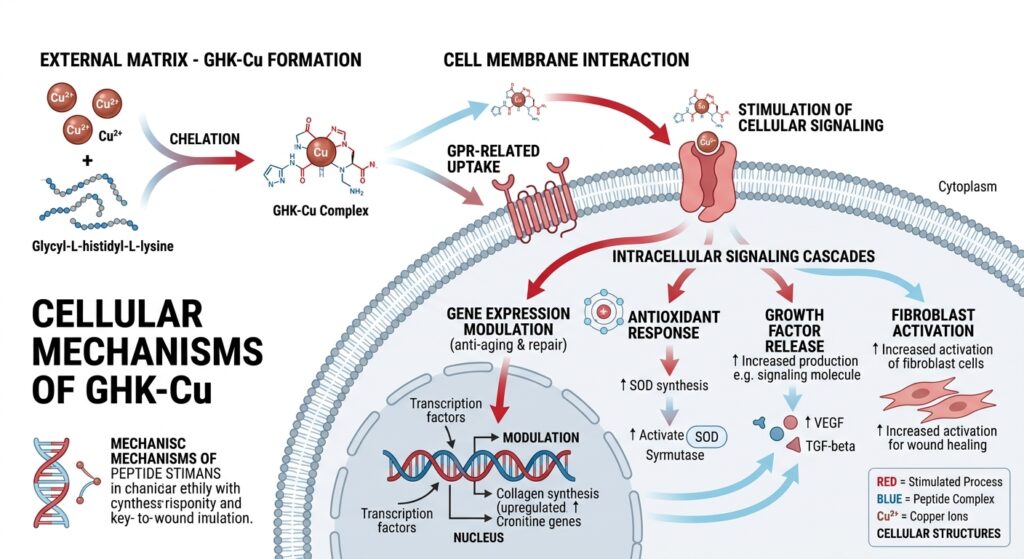
GHK-Cu, scientifically known as glycyl-L-histidyl-L-lysine copper, is a naturally occurring tripeptide complex characterized by its extremely high binding affinity for copper(II) ions ($Cu^{2+}$). First isolated from human plasma, this tripeptide complex functions as a crucial molecular carrier and signaling molecule. Within the context of biochemical and molecular research, synthetic GHK-Cu is extensively utilized in in-vitro studies to uncouple and map massive regulatory networks, specific genetic resets, and extracellular matrix remodeling cascades.

Structural Chemistry and Copper Binding
The structure of GHK (the tripeptide itself without copper) consists of Glycine, Histidine, and Lysine. Its primary biochemical importance revolves around its coordination chemistry. The amino nitrogen of the glycine residue, along with the imidazole nitrogen of the histidine residue, provide dedicated electron donation sites, forming a highly stable, square-planar coordination geometry with a single divalent copper ion.
This specific binding complex is not merely a transport mechanism. In in-vitro assays, the GHK-Cu complex behaves distinctly from free copper or the free peptide, possessing unique receptor affinities that dictate an expansive array of downstream cellular actions.
Gene Expression Regulation
One of the most consequential findings in recent molecular biology regarding GHK-Cu is its ability to radically modulate gene expression within in-vitro cell lines. Using broad-scale microarray data, scientists have demonstrated that introducing GHK-Cu to senescent human fibroblasts can upregulate and downregulate thousands of structural and signaling genes.
Notably, pathways associated with cellular repair, ubiquitin/proteasome systems (responsible for clearing damaged proteins), and DNA repair mechanisms are heavily unregulated. Conversely, gene clusters associated with overactive inflammatory cascades (such as those tied to NF-$kappa$B pathways) are frequently downregulated. The capability of a single tripeptide complex to enact such a widespread “reset” of genomic patterning makes it an invaluable tool for researchers studying epigenetic modifications.
Comprehensive analysis regarding the genetic resetting properties of GHK-Cu can be found in the International Journal of Molecular Sciences: Regenerative and Protective Actions of the GHK-Cu Peptide in the Light of the New Gene Data.
Extracellular Matrix (ECM) Remodeling In-Vitro
Outside the nucleus, GHK-Cu exerts significant influence over the extracellular matrix, particularly when evaluating dermal fibroblast cultures.
The tripeptide complex serves dual, ostensibly contradictory, roles that ultimately result in precise systemic regulation:
1. Stimulation of Synthesis: GHK-Cu strongly upregulates the secretion of structural proteins, most notably collagen (Types I and III), elastin, and vital glycosaminoglycans. It promotes the proliferation and migration of fibroblasts essential for tissue matrix construction.
2. Regulation of Breakdown: Simultaneously, GHK-Cu modulates the activity of matrix metalloproteinases (MMPs), the enzymes responsible for degrading existing cellular scaffolding, as well as their inhibitors (TIMPs).
This balanced interaction ensures the systematic replacement of damaged matrix architecture with newly synthesized scaffolding without leading to unchecked fibrotic overgrowth.
Original research demonstrating this precise stimulation of collagen synthesis within localized fibroblast cultures is foundational to ECM studies. See findings detailed in FEBS Letters: Stimulation of collagen synthesis in fibroblast cultures by the tripeptide-copper complex GHK-Cu.
Antioxidant and Anti-Inflammatory Pathways
In-vitro models examining oxidative stress utilize GHK-Cu to investigate localized antioxidant defenses. The complex provides cellular protection against radical-induced damage primarily by regulating the iron and copper levels available for Fenton reactions (which produce highly toxic hydroxyl radicals). Furthermore, GHK-Cu modulates inflammatory signaling molecules, suppressing the production of harmful oxidative species like Interleukin-6 (IL-6) in specific macrophage lineages while preserving the necessary elements for cellular defense.
For extensive reviews on its applications suppressing inflammatory cascades in isolated models, refer to BioMed Research International: The effect of GHK-Cu on gene expression relevant to inflammation.
Disclaimer: The content detailing GHK-Cu within this document is strictly for in-vitro research and educational purposes. All data presented relates solely to laboratory investigations and experimental models. GHK-Cu is not intended or approved for cosmetic applications, anti-aging therapies, skin treatments, or any form of human consumption. It should never be utilized for dosing, experimental injection, or expecting specific structural results outside of a controlled, non-human, laboratory environment.