

—
Cagrilintide: Amylin Analog Receptor Binding and In-Vitro Mechanisms
Cagrilintide represents a highly engineered, synthetic analog of the naturally occurring pancreatic peptide, amylin (also known as islet amyloid polypeptide or IAPP). Endogenous amylin is typically co-secreted with insulin by pancreatic beta cells. While vital to metabolic homeostasis, endogenous amylin exhibits significant physiochemical instability, rapid aggregation into amyloid fibrils, and an extremely short circulatory half-life, rendering it difficult to utilize in sustained in-vitro studies. Cagrilintide was explicitly designed to overcome these biochemical limitations, providing researchers with a stable, long-acting analog to precisely map amylin receptor (AMYR) pharmacology.

Pharmacological Engineering and Stability
The molecular architecture of Cagrilintide differs critically from endogenous human amylin. The primary structure has undergone specific amino acid substitutions to inhibit the pathological tendency of the peptide to self-aggregate into insoluble beta-sheet fibrils—a defining characteristic of native amylin in-vitro.
Furthermore, the defining feature of Cagrilintide’s design is its half-life extension technology. It is acylated with a specific C20 fatty diacid moiety connected via a hydrophilic linker. In in-vitro assays simulating serum conditions, this fatty acid chain allows Cagrilintide to reversibly bind to serum albumin with extraordinarily high affinity. This albumin binding acts as a slow-release reservoir, significantly protecting the peptide backbone from rapid enzymatic degradation by dipeptidyl peptidase-4 (DPP-4) and other circulating endopeptidases, thereby enabling extended experimental observation.
Amylin Receptor (AMYR) Pharmacology
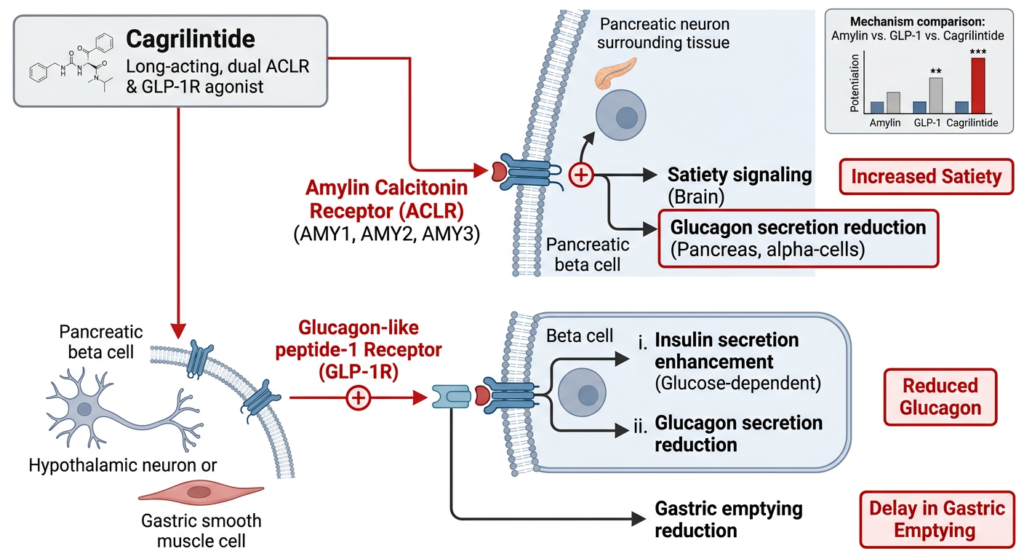
Cagrilintide acts as a powerful, non-selective agonist at multiple subtypes of the amylin receptor complex. The pharmacology of the amylin receptor is inherently complex. In-vitro mapping reveals that the AMYR is not a single, isolated receptor. Instead, it forms as a heterodimer complex consisting of the core calcitonin receptor (CTR) co-assembled with one of three required receptor activity-modulating proteins (RAMP1, RAMP2, or RAMP3).
Depending on the specific RAMP co-expressed on the cell membrane, the core CTR alters its affinity, creating distinct amylin receptor subtypes ($AMY_1$, $AMY_2$, and $AMY_3$). Cagrilintide demonstrates potent in-vitro binding and activation across all of these subtypes.
Once engaged, the receptor complex is a G-protein-coupled receptor (GPCR) that primarily couples to the stimulatory G-protein ($G_s$). Binding of Cagrilintide induces an intracellular cascade:
1. Activation of adenylate cyclase.
2. Significant elevation of intracellular cyclic AMP (cAMP) levels.
3. Activation of downstream protein kinase A (PKA) pathways.
This cellular signaling pathway regulates the profound metabolic functions observed in biological assays.
Synergistic Receptor Dynamics
A significant vector of current in-vitro research involves studying the synergistic signaling pathways when Cagrilintide is administered alongside Glucagon-Like Peptide-1 (GLP-1) analogs (such as semaglutide). Preclinical bench assays indicate that these two distinct receptor populations (AMYR and GLP-1R)—which exist on separate neural and endocrine cell lineages—trigger additive or even synergistic downstream metabolic cascades when activated concurrently. Investigating this dual-agonist mechanism is crucial for expanding our understanding of multi-hormonal metabolic regulation.
For an extensive review tracing the molecular mechanics and dual-agonist potential within experimental models, see the Trends in Molecular Medicine publication: Dual hormone co-agonists for treatment of obesity.
Disclaimer: The content detailing Cagrilintide within this document is strictly for in-vitro research and educational purposes. All data presented relates solely to laboratory investigations, receptor binding assays, and experimental models. Cagrilintide is not intended or approved for human consumption, weight loss, fat loss, or medical intervention. It should never be utilized for dosing, experimental injection, or expecting specific cosmetic results outside of a controlled, non-human, laboratory environment. Any mention of weight management studies relates strictly to the established literature context and not product application.