

MOTS-c: Evaluating Mitochondrial-Nuclear Retrograde Signaling in Vitro Models
Apr 2, 2025
Introduction: The Shift from Nuclear to Mitochondrial Encoding
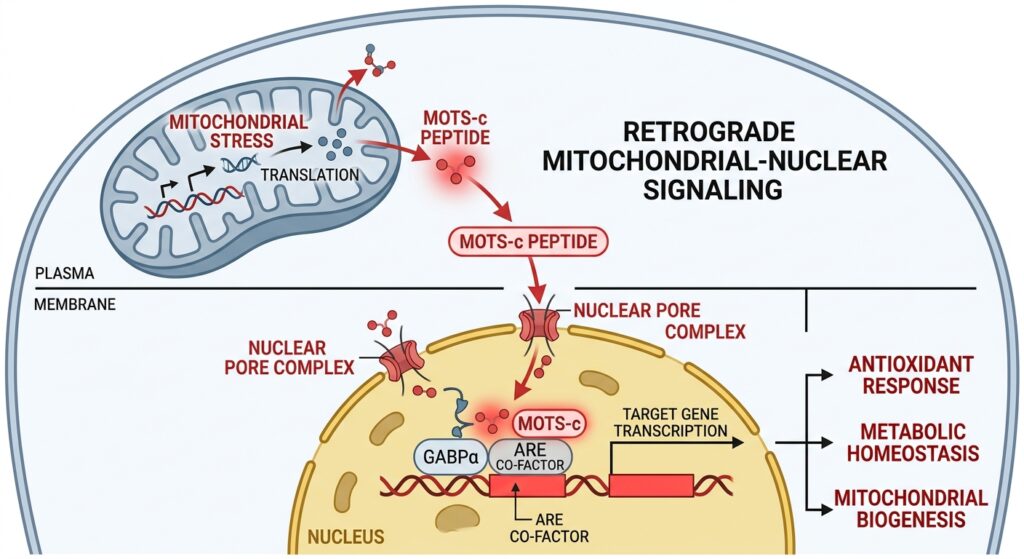
The prevailing paradigm of cellular biology dictates that functional peptides are predominantly synthesized via transcription of nuclear DNA. However, the discovery of Mitochondrial Open Reading Frame of the 12S rRNA type-c (MOTS-c) fundamentally shifted this dogma. MOTS-c is a 16-amino acid peptide encoded not within the cell nucleus, but directly from the circular mitochondrial genome (mtDNA). This endogenous molecule acts as a critical mediator of intracellular retrograde signaling—a mechanism whereby the mitochondria communicate metabolic status back to the nucleus to induce adaptive transcriptional changes. Within isolated in-vitro tissue and cellular models, MOTS-c is rigorously studied to map its pathways regarding intracellular stress modulation and basal metabolic homeostasis.
Mechanistic Profile in Vitro: The AMPK-Crosstalk and Nuclear Translocation
In controlled laboratory environments utilizing isolated cellular arrays (such as cultured myocytes or endothelial cells), the molecular activity of exogenous and endogenous MOTS-c reveals a highly complex mechanism of action centered around energy sensing and transcriptional reprogramming.
The AMPK Activation Cascade
The primary observed pharmacological action in vitro following cellular uptake or endogenous stabilization of MOTS-c is the potent dose-dependent activation of AMP-activated protein kinase (AMPK).
- Metabolic Stress Simulation: Under conditions of in-vitro nutrient deprivation or induced oxidative stress, intracellular ATP levels decline, raising the AMP:ATP ratio.
- Folate Cycle Inhibition: Research suggests MOTS-c directly inhibits the folate cycle de novo purine biosynthesis, utilizing an intermediate, 5-aminoimidazole-4-carboxamide ribonucleotide (AICAR), structurally analogous to AMP.
- AMPK Phosphorylation: This accumulation of AMP-analogous molecules triggers the phosphorylation of AMPK at key regulatory domains (e.g., Thr172) by upstream kinases like LKB1.
- Metabolic Reprogramming: Activated AMPK acts as a metabolic master switch, upregulating catabolic networks (such as glucose uptake via GLUT4 translocation and fatty acid oxidation) while downregulating ATP-consuming anabolic networks in the isolated cell models.
Retrograde Nuclear Translocation
Beyond kinase activation, advanced structured illumination microscopy on stressed in-vitro cultures has demonstrated a striking physical phenomenon: under severe metabolic stress, MOTS-c peptides translocate from the mitochondria and cytosol directly into the cellular nucleus. Once localized in the nucleus, MOTS-c functions as an active transcriptional co-regulator. It binds to promoter regions of nuclear DNA containing Antioxidant Response Elements (ARE), interacting with transcription factors such as Nfe2l2 (Nrf2) to induce the expression of cyto-protective and antioxidant genes.
(Reynolds et al., 2021: MOTS-c: A mitochondrial signal regulating metabolism and aging)
Exploring Target Cellular Pathologies in Vitro
The profound metabolic effects of MOTS-c have led researchers to utilize it as a primary investigative tool against cellular models of oxidative stress and mechanical injury.
Oxidative Cytoprotection and Nrf2 Activation
Recent empirical in-vitro studies frequently measure MOTS-c’s ability to preserve cellular integrity against profound oxidative environments (e.g., hyperoxia exposure assays). Data indicates that in controlled settings, MOTS-c upregulates the Nuclear factor erythroid 2-related factor 2 (Nrf2) pathway. For example, studies detailing LAT1-mediated delivery of engineered R13A-MOTS-c attenuates radiation-induced lung injury via Nrf2 activation and mitochondrial protection demonstrate that facilitating cellular uptake of synthesized MOTS-c analogs provides quantifiable protection to mitochondrial membrane potential against radiation.
Similarly, other inquiries like Mitochondria-derived peptide MOTS-c alleviates hyperoxia-induced bronchopulmonary dysplasia in neonatal mice by activating Nrf2 pathway isolate these pathways to determine structural stability within pulmonary cellular structures subject to hypoxic or hyperoxic extremes.
Inhibition of Cellular Apoptosis and Oxeiptosis
Furthermore, researchers track the peptide’s ability to interfere with terminal cellular degradation pathways in vitro. Specific investigations into cardiac tissue structural models, such as MOTS-c attenuates hyperoxia-induced neonatal cardiac injury by inhibiting oxeiptosis via maintaining the KEAP1-PGAM5 interaction, map how MOTS-c interactions prevent the breakdown of structural complexes essential for preventing oxeiptosis (a caspase-independent form of cell death driven by extreme oxidation), thus indicating a high level of protective structural maintenance inside severe in-vitro conditions.
(Kim et al., 2018: Mitochondrial peptides as regulators of metabolism)
Conclusion
In-vitro research concerning MOTS-c fundamentally redefines how investigators map intracellular communication. By acting both as a potent activator of the AMPK energy-sensing cascade and as a direct nuclear transcriptional co-regulator, MOTS-c demonstrates an intricate retrograde signaling pathway. Current laboratory metrics continue to track its quantifiable efficiency in maintaining cellular morphology and viability against chemically induced oxidative degradation environments.
References:
- Lee, C., et al. (2015). The mitochondrial-derived peptide MOTS-c promotes metabolic homeostasis and reduces obesity and insulin resistance. Cell Metabolism, 21(3), 443–454. Link
- Kim, K.H., et al. (2018). Mitochondrial peptides as regulators of metabolism. Cell Metabolism, 28(3), 330–341. Link
- Reynolds, J.C., et al. (2021). MOTS-c: A mitochondrial signal regulating metabolism and aging. Frontiers in Endocrinology, 12, 678778. Link
- LAT1-mediated delivery of engineered R13A-MOTS-c attenuates radiation-induced lung injury via Nrf2 activation and mitochondrial protection.
- MOTS-c attenuates hyperoxia-induced neonatal cardiac injury by inhibiting oxeiptosis via maintaining the KEAP1-PGAM5 interaction.
- Mitochondria-derived peptide MOTS-c alleviates hyperoxia-induced bronchopulmonary dysplasia in neonatal mice by activating Nrf2 pathway.
Disclaimer: All content and information are strictly for analytical, in-vitro laboratory research purposes only. Not intended for human or animal consumption.
