

Abstract
Growth Hormone-Releasing Hormone (GHRH) is the endogenous 44-amino acid hypothalamic peptide responsible for driving the somatotropic axis. While incredibly potent, native GHRH is extremely labile in physiological media, undergoing rapid proteolytic destruction primarily mediated by Dipeptidyl Peptidase IV (DPP-4). Tesamorelin is a synthetically modified, full-length human GHRH analogue engineered to overcome this inherent instability. By conjugating a trans-3-hexenoic acid moiety to the extreme N-terminus of the amino acid chain, chemists successfully shielded the peptide’s most vulnerable cleavage site. This rigorous structural review examines the in vitro biomechanics of Tesamorelin, contrasting its remarkable enzymatic resistance against its uncompromised ability to activate the classical cAMP-dependent signaling cascades required for robust growth hormone exocytosis within isolated pituitary models.
1. Introduction: The Fragility of Native Endocrine Signals
To rigorously study the downstream metabolic effects of prolonged growth hormone secretion in controlled cellular assays, researchers must maintain a steady upstream signal.
When native human GHRH(1-44) is introduced into standard in vitro culture media containing dilute serum or plasma extracts, its effective half-life ($t_{1/2}$) is often measured in minutes. This extreme instability makes capturing accurate dose-response curves incredibly difficult.
The primary culprit for this rapid destruction is Dipeptidyl Peptidase IV (DPP-4). DPP-4 is a highly ubiquitous serine exopeptidase heavily expressed on the surface of immune cells and freely circulating in plasma. It specifically targets and forcefully cleaves the peptide bond immediately following a Proline or Alanine residue located at the penultimate (second) position from the N-terminus.
Because the sequence of native GHRH begins with Tyrosine-Alanine ($Tyr^1-Ala^2$), it is considered a perfect, high-affinity substrate for rapid DPP-4 truncation.
2. Structural Engineering: The Trans-3-Hexenoyl Moiety
To create an analogue capable of surviving the enzymatic environment without sacrificing receptor binding affinity, biochemists focused entirely on the extreme N-terminus.
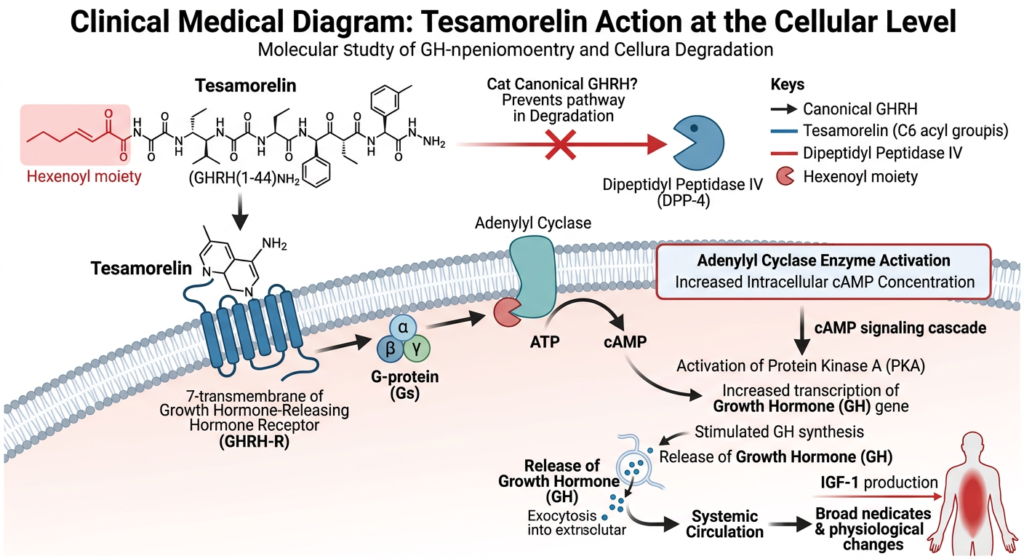
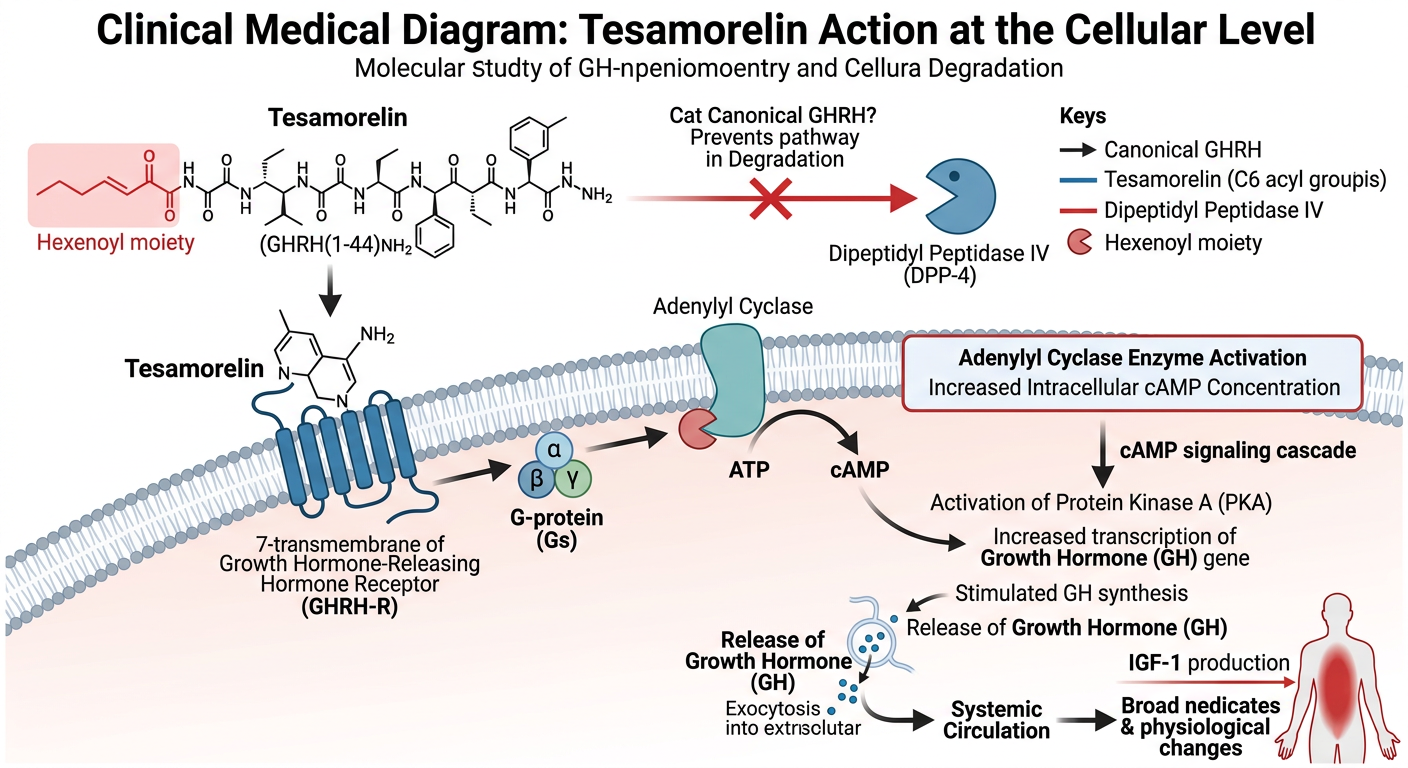
Tesamorelin is identical in amino acid sequence to native human GHRH(1-44). However, it possesses a critical, synthetic appendage specifically at the absolute front of the molecule. A lipid-like, trans-3-hexenoic acid group (often referred to as a hexenoyl moiety) is covalently conjugated directly to the primary amine of the first amino acid (Tyrosine).
2.1 Complete Evasion of DPP-4 Cleavage
This specific structural addition serves as a powerful molecular shield. In comparative in vitro degradation assays utilizing purified human plasma:
* Native GHRH is rapidly cleaved between $Ala^2$ and $Asp^3$, yielding an inactive (3-44) fragment that no longer binds the GHRH receptor.
* Conversely, the trans-3-hexenoyl group on Tesamorelin introduces significant steric bulk and drastically alters the electrostatic charge topography of the N-terminus.
The active site of the DPP-4 enzyme can no longer recognize the $Tyr^1-Ala^2$ sequence. In vitro data demonstrates that Tesamorelin possesses near-absolute resistance to DPP-4 mediated cleavage, fundamentally shifting its stability curve and radically extending its functional persistence in biological media.
3. Preserved Receptor Mechanics: The $G_s$/cAMP Cascade
While altering the N-terminus protects the peptide, it is functionally useless if the modification prevents the peptide from activating its target receptor. In vitro competitive binding assays utilizing cloned human GHRH receptors expressed on Chinese Hamster Ovary (CHO) cell lines confirm that, despite the bulky hexenoyl appendage, Tesamorelin retains a binding affinity ($K_d$) nearly identical to native GHRH.
3.1 Intracellular Transduction
Once docked to the GHRH receptor on the surface of a somatotroph, Tesamorelin initiates the exact physiological cascade required for exocytosis:
1. G-Protein Coupling: The receptor undergoes a conformational shift, activating the stimulatory $G_{salpha}$ protein subunit.
2. cAMP Generation: The freed $G_{salpha}$ subunit violently upregulates the activity of the integral membrane enzyme Adenylyl Cyclase, converting massive amounts of intracellular ATP into cyclic AMP (cAMP).
3. Kinase Activation: The surging cAMP binds to the regulatory subunits of Protein Kinase A (PKA), unleashing its catalytic subunits.
3.2 Translating Signal to Secretion
In isolated pituitary cell cultures, the activated PKA performs two critical tasks. First, it phosphorylates specific voltage-gated calcium channels, promoting an immediate influx of extracellular $Ca^{2+}$ that triggers the physical exocytosis of stored Growth Hormone secretory granules.
Secondarily, PKA translocates to the nucleus to phosphorylate CREB (cAMP response element-binding protein). Activated CREB binds to DNA promoter regions, forcing the continuous de novo transcription and synthesis of new Growth Hormone, ensuring the somatotroph does not deplete its reserves during prolonged stimulation.
4. In Vitro Metabolic Mapping and Lipolysis
Because Tesamorelin survives significantly longer in physiological media than previous analogues, it allows researchers to build advanced co-culture models to study the peripheral effects of the resulting GH surge.
For example, when isolated pituitary somatotrophs are co-cultured with primary human adipocytes (fat cells), prolonged stimulation of the somatotrophs via Tesamorelin leads to a massive, sustained release of GH into the generalized culture media.
Researchers can directly measure tracking markers—like glycerol and free fatty acids (FFAs)—released by the adipocytes. This confirms that the downstream GH surge specifically targets the adipocytes, powerfully upregulating Hormone-Sensitive Lipase (HSL) via the JAK2/STAT5 pathway, driving aggressive lipolysis (fat breakdown) without requiring systemic in vivo clearance mechanisms.
5. Conclusion
Tesamorelin is a paradigm of targeted rational peptide design. By definitively identifying Dipeptidyl Peptidase IV as the rapid terminator of native GHRH signaling, chemists explicitly neutralized the threat through the N-terminal conjugation of a trans-3-hexenoyl shield. Thorough in vitro validations confirm that this modification confers profound enzymatic independence while perfectly preserving the classical, cAMP-driven somatotropic activation required for physiological function. Consequently, Tesamorelin stands as a premier stabilized analogue for researchers seeking to accurately map the complex downstream pathways governing systemic lipolysis and metabolic homeostasis in fully controlled cellular matrices.
Scientific References & Further Reading:
- Ferdinandi, E. S., et al. (2007). Pharmacokinetics and disposition of the growth hormone-releasing factor TH9507 in rats and dogs. Biopharmaceutics & Drug Disposition, 28(2), 51-60.
- Rivier, J., et al. (1982). Characterization of a growth hormone-releasing factor from a human pancreatic islet tumour. Nature, 300(5890), 276-278.
- Falutz, J., et al. (2010). Metabolic effects of a growth hormone–releasing factor in patients with HIV. The New England Journal of Medicine, 363(8), 716–726.
- Stanley, T.L., et al. (2011). Effects of tesamorelin on visceral fat and metabolic parameters in HIV-infected patients. Journal of Clinical Endocrinology & Metabolism, 96(9), 2738–2745.
(Disclaimer: The content detailed above is intended strictly for in vitro laboratory research and academic reference. Synthetic peptides discussed herein are not approved, designed, or strictly evaluated for human consumption, diagnostics, or therapeutic interventions.)