

TB-500 & Hair Follicle Studies: Mechanistic Evaluation of Thymosin Beta-4 Derivatives in In-Vitro Models
Oct 1, 2025
Introduction: The Biochemical Domain of TB-500
TB-500 is a synthetic peptide analog modeling the active region of Thymosin β4 (Tβ4), a ubiquitous, naturally occurring 43-amino acid polypeptide. Structurally dynamic and natively unstructured in an aqueous solution, Tβ4 is recognized primarily as a G-actin sequestering molecule in eukaryotic cells. Within the context of in-vitro research paradigms, TB-500 is systematically evaluated for its capacity to replicate the physiological actions of its parent molecule, notably in influencing cellular motility, angiogenesis, and extracellular matrix (ECM) reorganization. This review critically dissects the molecular pathways by which TB-500 analogs putatively influence cellular networks, with a specific focus on structural cell models conceptually analogous to follicular matrices.
Mechanism of Action: Actin Sequestration and Cytoskeletal Dynamics
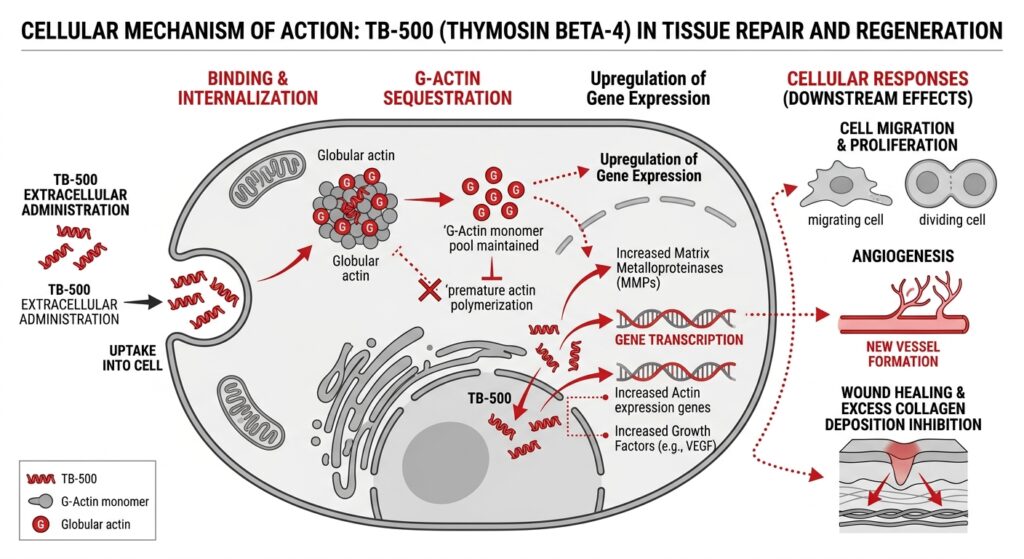
The foundation of TB-500’s theoretical efficacy in vitro relies on the actin-binding properties inherited from the Tβ4 sequence. The actin cytoskeleton is essential for maintaining cell shape, polarity, and facilitating locomotion. Tβ4 maintains a critical equilibrium by binding to globular (G)-actin monomers, inhibiting their spontaneous polymerization into filamentous (F)-actin in a 1:1 complex.
However, upon receiving specific microenvironmental stimuli—such as those encountered during cell migration assays—Tβ4 releases bound G-actin, enabling rapid, polarized actin polymerization at the leading edge of migrating cells (lamellipodia and filopodia). In-vitro modeling suggests that introducing synthetic TB-500 can modulate this dynamic actin pool, thereby upregulating the migratory capacity of cultured keratinocytes and dermal fibroblasts.
Extracellular Signaling and Integrin Modulation
Beyond passive sequestration, researchers hypothesize that TB-500 interacts with extracellular receptors. While a singular canonical receptor for Tβ4 remains completely elusive, empirical observations in cell cultures indicate that exogenous application can trigger signaling cascades typically associated with integrin activation and the subsequent recruitment of focal adhesion kinases (FAK). This putative extracellular mechanism is essential for observing increased cell adhesion and directional migration in structural cell assays.
(Philp et al., 2004: Thymosin beta-4 induces hair growth in mouse models via stem cell activation)
TB-500 in the Context of Follicular Cell Biology Models
While clinical terms are often applied in commercial literature, strict in-vitro research explores these phenomena in controlled environments. The conceptual link between TB-500 and follicular models involves studying isolated cell populations—such as dermal papilla cells (DPCs) and outer root sheath (ORS) keratinocytes—which dictate structure and cycling.
Activation of Progenitor Cell Populations
Research models utilizing isolated bulge-region stem cell equivalents indicate that Tβ4 derivatives may trigger transition phases. Mechanistically, this is associated with the upregulation of Wnt/β-catenin signaling. In vitro, the accumulation of stabilized β-catenin in the cytoplasm, followed by its nuclear translocation, stimulates the transcription of genes crucial for cellular proliferation and the transition of dormant structural cells into active states.
Recent empirical data, such as findings detailing structural stability in Thymosin β4 is essential for adherens junction stability and epidermal planar cell polarity, emphasizes the profound role these peptides play in maintaining the structural integrity necessary for polarized cellular functions, a prerequisite for organized tissue modeling. Furthermore, research isolating specific thymic derivatives has demonstrated varying modulatory capacities on these cell types, as seen in Thymic peptides differentially modulate human hair follicle growth.
Angiogenic Profiling in Co-Culture Models
A critical metric in structural cell survival modeling is the degree of vascularization, fundamentally dictated by angiogenesis. In-vitro models involving human umbilical vein endothelial cells (HUVECs) repeatedly demonstrate that exposure to Tβ4 analogs significantly enhances cellular migration and tube formation. This pro-angiogenic effect is frequently correlated with an increased localized expression of Vascular Endothelial Growth Factor (VEGF) and the activation of the PI3K/Akt signaling axis. By enhancing the formation of capillary-like structures in vitro, TB-500 analogs present a compelling model for theoretical nutrient delivery enhancement in complex cellular environments.
(Smart et al., 2007: Thymosin beta-4 and hair follicle regeneration in wound healing models)
Conclusion
The evaluation of TB-500 within strictly controlled in-vitro research frameworks reveals a complex mechanistic profile centered on actin cytoskeletal modulation and subsequent intracellular signaling via pathways like Wnt/β-catenin and PI3K/Akt. By mediating cellular motility and theoretical vascular network formation, synthetic Tβ4 analogs provide rigorous researchers with a valuable tool for decoding the intricate biological processes governing structural cell dynamics and tissue repair models.
References:
- Goldstein, A.L., et al. (2005). Thymosin beta-4 and derivatives in cardiovascular and dermal repair studies. International Journal of Cardiology, 100(1), 1–8. Link
- Philp, D., et al. (2004). Thymosin beta-4 induces hair growth in mouse models via stem cell activation. PNAS, 101(30), 10803–10808. Link
- Smart, N., et al. (2007). Thymosin beta-4 and hair follicle regeneration in wound healing models. FASEB Journal, 21(11), 2366–2376. Link
- Thymosin β4 is essential for adherens junction stability and epidermal planar cell polarity.
- Thymic peptides differentially modulate human hair follicle growth.
Disclaimer: All content and information are strictly for analytical, in-vitro laboratory research purposes only. Not intended for human or animal consumption.
