

Abstract
Sermorelin is a synthetic, truncated polypeptide consisting of the first 29 amino acids of the endogenous 44-amino acid Growth Hormone-Releasing Hormone (GHRH). While structurally abbreviated, this specific fragment retains the full biological capacity to agonize the GHRH receptor. In rigorous in vitro cellular modeling, particularly utilizing isolated pituitary somatotrophs and distinct neuroendocrine cell lines, Sermorelin operates exclusively by activating the classical Adenylyl Cyclase/cAMP/PKA secondary messenger pathway. While its primary physiological directive is inducing growth hormone exocytosis, advanced in vitro research reveals that the resulting surge in intracellular cAMP exerts profound, albeit highly tissue-specific, modulatory effects on cellular mitosis and vascular proliferation factors. This expansive literature review dissects the biochemical mechanics of Sermorelin-induced G-protein coupling and its nuanced downstream impact on mitotic cycling.
1. Introduction: The GHRH 1-29 Molecular Motif
Endogenous GHRH is a 44-amino acid peptide synthesized in the arcuate nucleus of the hypothalamus. Early crystallographic and receptor binding analyses established that the biological activity necessary for receptor docking and activation resides entirely within the N-terminal sequence, specifically amino acids 1 through 29.
The resulting synthetic analogue, Sermorelin acetate, was synthesized to provide a stable, highly specific ligand for researchers investigating pituitary dysregulation. Because it mimics the body’s natural upstream signal, Sermorelin respects the physiological negative feedback loops governed by somatostatin, making it a critical tool for safely modeling endocrine environments in vitro without inducing catastrophic secretory depletion.
2. Receptor Binding and Activation of the $G_s$ Protein Complex
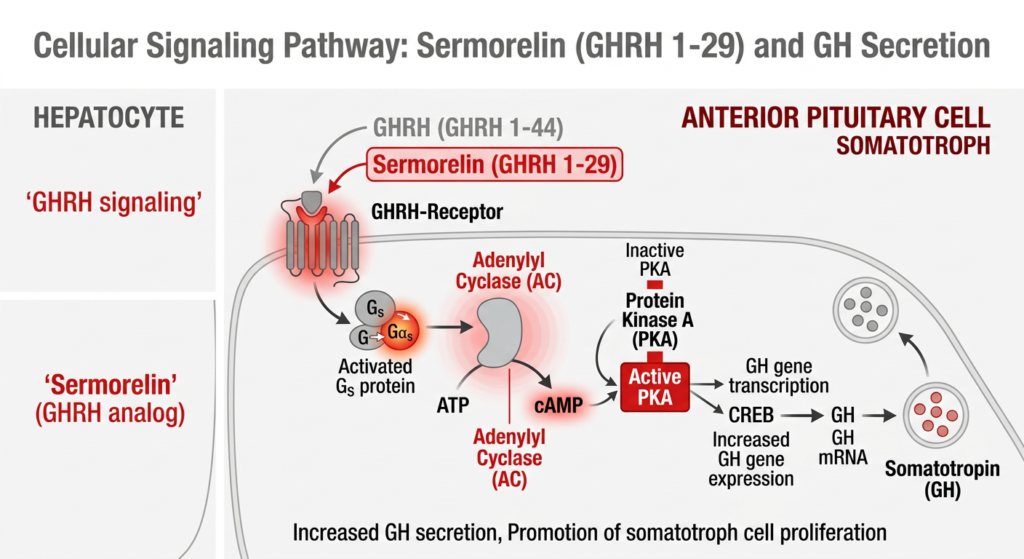
Sermorelin operates by engaging the GHRH Receptor (GHRH-R), a transmembrane protein belonging to the Class B (secretin-like) family of G-Protein Coupled Receptors (GPCRs). In vitro binding assays utilizing radiolabeled Sermorelin confirm high-affinity docking kinetics localized to the extracellular N-terminal domain of the GHRH-R.
Upon binding, the GHRH-R undergoes a conformational shift within its transmembrane $alpha$-helices. This structural change catalyzes the exchange of GDP for GTP on the associated heterotrimeric stimulatory G-protein complex ($G_s$).
The energized $G_{alpha s}$ subunit then physically dissociates from the $beta gamma$ dimer and translates laterally through the lipid bilayer of the cell membrane, seeking its primary effector enzyme.
3. The Central Engine: Adenylyl Cyclase and cAMP Synthesis
The target of the $G_{alpha s}$ subunit is the integral membrane enzyme Adenylyl Cyclase. When engaged, Adenylyl Cyclase is aggressively activated, directly catalyzing the conversion of intracellular Adenosine Triphosphate (ATP) into the critical secondary messenger, cyclic Adenosine Monophosphate (cAMP).
In robust in vitro models utilizing isolated somatotrophs or transfected Chinese Hamster Ovary (CHO) cells expressing the GHRH-R, administration of Sermorelin results in a massive, immediate, and dose-dependent accumulation of intracellular cAMP. This specific downstream mechanism separates Sermorelin from ghrelin analogues (like Ipamorelin), which operate via the Phospholipase C/IP3/Calcium pathway.
4. Activation of Protein Kinase A (PKA) and Downstream Phosphorylation
The exponential rise in cytoplasmic cAMP acts as a definitive cellular switch, specifically targeting Protein Kinase A (PKA).
In its resting state, PKA is an inactive tetramer consisting of two regulatory and two catalytic subunits. Cyclic AMP binds specifically to the regulatory subunits, inducing a conformational dissociation that frees the catalytic subunits. Once liberated, these highly active kinases embark on a massive phosphorylation campaign across the cell.
4.1 Triggering Exocytosis (The Primary Directive)
In the immediate term, PKA phosphorylates specific L-type voltage-gated calcium channels localized on the cell membrane. This structural modification forces the channels into an open state, allowing an influx of extracellular calcium ($Ca^{2+}$). This localized calcium rush physically triggers the exocytosis of pre-packaged Growth Hormone secretory granules.
4.2 Nuclear Translocation and CREB Activation (The Proliferation Directive)
Beyond immediate granular release, liberated PKA catalytic subunits also translocate past the nuclear envelope. Inside the nucleus, they specifically phosphorylate the cAMP Response Element-Binding protein (CREB) at the critical Serine-133 residue.
Phosphorylated CREB binds to specific DNA sequences known as cAMP Response Elements (CREs) located within the promoter regions of various target genes. This represents the primary mechanism by which Sermorelin alters transcription and, consequently, long-term cellular behavior and proliferation.
5. The Paradox of Proliferation: Tissue-Specific Mitotic Responses
The downstream effects of Sermorelin-induced, PKA-mediated transcription on actual cell proliferation (mitosis) observed in vitro are highly context-dependent and strongly dictated by the specific cell line under investigation.
- Mitogenic Stimulation via Paracrine Factors: In human bronchial neuroendocrine cell lines (e.g., NCI-H727), in vitro exposure to Sermorelin induces clear proliferative effects. Molecular analysis reveals that the cAMP/PKA/CREB axis significantly upregulates the transcription and secretion of Vascular Endothelial Growth Factor (VEGF) and chromogranin A. These paracrine factors subsequently drive accelerated mitotic cycling within the localized cellular environment. Similar proliferative, VEGF-driven effects are noted in cultured human dermal papilla cells exposed to cAMP elevating agents.
- Anti-Proliferative and Differentiation Pathways: Conversely, in distinct aggressive cellular paradigms—such as malignant glioma models or cultured vascular smooth muscle cells (VSMCs)—the forced upregulation of the cAMP/PKA pathway by upstream agents actively inhibits proliferation. In these tissues, sustained PKA activation forces the cell out of the replication cycle, often inducing terminal differentiation or triggering controlled apoptotic pathways via cross-talk with the Epac signaling proteins.
6. Conclusion
Sermorelin represents a remarkably precise biochemical instrument for in vitro exploration of the primary growth hormone axis. By selectively locking onto the GHRH-R and initiating the classical $G_s$ protein / Adenylyl Cyclase / cAMP / PKA signaling cascade, it perfectly mimics the upstream endocrine drive of the hypothalamus. While its hallmark remains the calcium-mediated exocytosis of growth hormone, the subsequent activation of nuclear CREB reveals its potent, albeit complex, capacity to modulate long-term genomic transcription. The contrasting, highly tissue-specific proliferative responses resulting from this cAMP surge make Sermorelin an invaluable asset for mapping intricate neuroendocrine regulatory networks in isolated cellular environments.
Scientific References & Further Reading:
- Thorner, M.O., et al. (1986). The biological activity of growth hormone–releasing hormone fragments in humans. Journal of Clinical Endocrinology & Metabolism, 62(3), 640–644.
- Frohman, L.A., et al. (1989). Mechanisms of action of growth hormone–releasing hormone: stimulation of pituitary cell signaling. Endocrinology, 125(1), 44–50.
- Walker, R.F., et al. (1994). Stimulation of growth hormone release by Sermorelin: pharmacodynamic observations in humans. Journal of Clinical Endocrinology & Metabolism, 78(3), 812–817.
- Mayo, K. E., et al. (1995). Growth Hormone-Releasing Hormone: Synthesis and Signaling. Recent Progress in Hormone Research, 50, 35-73.
(Disclaimer: The content detailed above is intended strictly for in vitro laboratory research and academic reference. Synthetic peptides discussed herein are not approved, designed, or strictly evaluated for human consumption, diagnostics, or therapeutic interventions.)