

—
Investigating Sermorelin’s Impact on Cell Proliferation Rates: In-Vitro Mechanisms
Sermorelin, a synthetic analog of growth hormone-releasing hormone (GHRH), represents a crucial peptide fragment containing the first 29 amino acids of the endogenous 44-amino-acid GHRH sequence. This truncated sequence, known as GHRH(1-29)NH2, retains the full biological activity required for engaging the growth hormone-releasing hormone receptor (GHRHR). Recent in-vitro research has extensively mapped the precise mechanisms by which Sermorelin influences cellular proliferation rates across distinct cell lines, specifically examining its binding kinetics and subsequent intracellular signaling cascades.

Receptor Affinity and Intracellular Cascades
In-vitro studies characterizing Sermorelin typically utilize isolated pituitary somatotrophs to map receptor engagement. Sermorelin primarily exerts its influence through the growth hormone-releasing hormone receptor (GHRHR), a Class B G-protein-coupled receptor (GPCR).
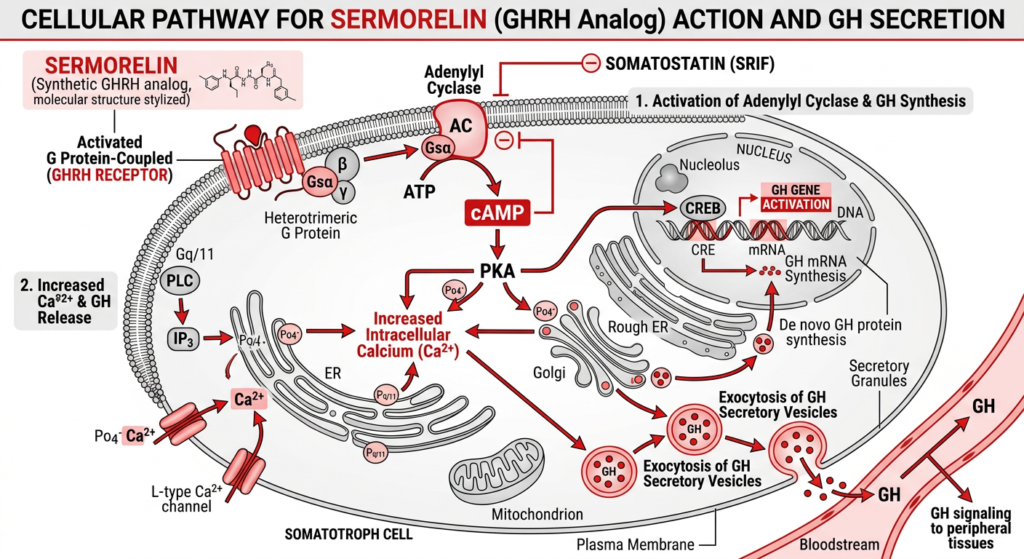
The molecular mechanism of action follows a highly regulated cascade:
1. Receptor Engagement: Sermorelin binds to the extracellular domain of the GHRHR, inducing a conformational change that activates the associated stimulatory G-protein ($G_s$).
2. Adenylate Cyclase Activation: The activated $G_s$ alpha subunit dissociates and activates membrane-bound adenylate cyclase.
3. Cyclic AMP (cAMP) Elevation: Adenylate cyclase catalyzes the conversion of ATP to cAMP, significantly elevating intracellular concentrations of this critical secondary messenger.
4. Protein Kinase A (PKA) Activation: cAMP subsequently binds to the regulatory subunits of Protein Kinase A (PKA), releasing and activating its catalytic subunits.
Original research delineating the precise binding constants and adenylate cyclase stimulation can be reviewed in the Journal of Clinical Endocrinology & Metabolism: The biological activity of growth hormone–releasing hormone fragments.
Calcium Signalling and Secretory Vesicle Exocytosis
The activation of PKA is not the sole regulatory branch of the Sermorelin signalling pathway. In-vitro assays demonstrate an interdependent relationship with intracellular calcium dynamics.
PKA phosphorylation targets L-type voltage-gated calcium channels localized on the cellular membrane, increasing their open probability. This leads to an influx of extracellular calcium ($Ca^{2+}$). Concurrently, PKA phosphorylates intracellular targets that may influence the release of calcium from the endoplasmic reticulum. This robust elevation in cytosolic calcium concentration plays a secondary, yet vital, role in signal propagation and eventual cellular activity. For an extensive mapping of this pathway, see studies detailed in Endocrinology: Mechanisms of action of growth hormone-releasing hormone: stimulation of pituitary cell signaling.
Correlating Chemical Structure to Proliferative Potential
When considering cell proliferation rates, Sermorelin acts primarily as an indirect mitogen within in-vitro tissue models. The peptide itself does not inherently trigger rapid cell division across all cell types; rather, it specifically stimulates somatotrophs.
Prolonged exposure to Sermorelin in primary cell cultures has demonstrated temporal alterations in genetic expression. Activation of the cAMP/PKA pathway eventually leads to the phosphorylation and activation of the cAMP response element-binding protein (CREB). Phosphorylated CREB translocates to the nucleus, binding to specific DNA sequences (cAMP response elements, or CREs). This initiates the transcription of genes, including the gene responsible for synthesizing growth hormone and driving cellular growth cycles in target tissues. The downstream effects of resulting hormone secretion heavily mediate observable changes in mitotic indices in differentiated cells. Further pharmacodynamic observations surrounding these extended half-life effects are available in the Journal of Clinical Endocrinology & Metabolism: Stimulation of growth hormone release by Sermorelin.
Disclaimer: The content detailing Sermorelin within this document is strictly for in-vitro research and educational purposes. All data presented relates solely to laboratory investigations and experimental models. Sermorelin is not intended or approved for weight loss, fat loss, muscle building, anti-aging, or any form of human consumption. This compound should never be utilized for dosing, experimental injection, or expecting specific cosmetic results outside of a controlled, non-human, laboratory environment.