

Mass Spectrometry in Peptide Research: A Mechanistic Evaluation of Analytical Methodologies in In-Vitro Frameworks
Oct 11, 2025
Introduction: The Nexus of Analytical Chemistry and Peptide Science
The elucidation of peptide structure and function represents a critical frontier in molecular biology and analytical chemistry. In the context of in-vitro research frameworks, mass spectrometry (MS) has emerged as an indispensable methodology. This analytical technique facilitates the precise determination of mass-to-charge ratios (m/z) of ionized molecules, enabling the highly sensitive characterization of complex peptide mixtures, synthetic preparations, and endogenous biological analytes. This review explores the mechanistic underpinnings of mass spectrometry protocols and their critical applications in advancing our understanding of peptide behavior.
(Aebersold & Mann, 2003: Mass spectrometry-based proteomics)
Mechanistic Principles of Mass Spectrometric Analysis
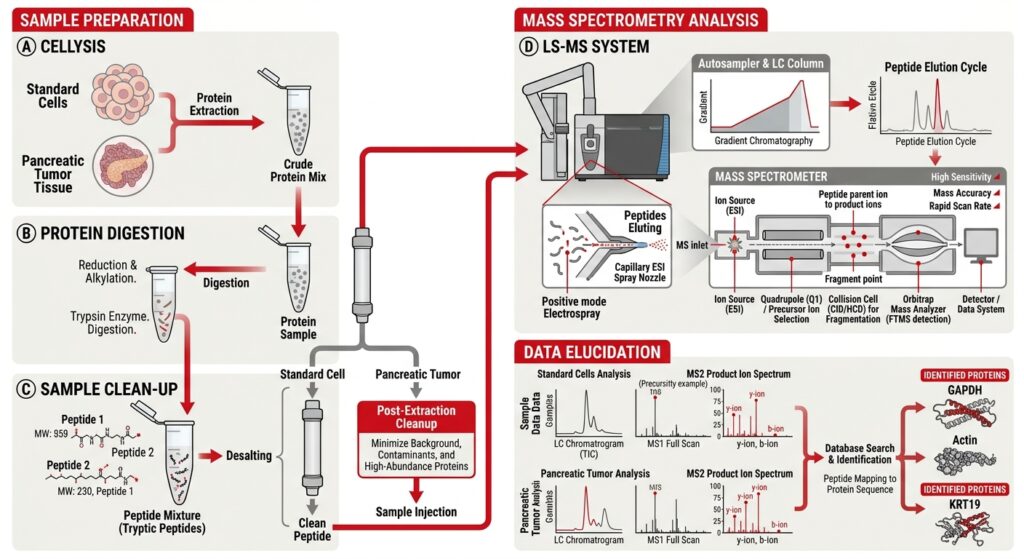
Mass spectrometry relies fundamentally on the conversion of target analytes into gas-phase ions. In peptide research, this requires techniques that preserve the structural integrity of relatively large and fragile macromolecular assemblies. Once ionized, the particles are subjected to electric and/or magnetic fields within a mass analyzer, facilitating their separation based on individual m/z ratios. Subsequent detection yields a characteristic mass spectrum computationally analyzed to derive structural and compositional data.
Structural Verification and Modification Mapping
Synthetic peptides, irrespective of the precision of solid-phase peptide synthesis (SPPS) protocols, are invariably subject to generating sequence truncations, deletions, and unintended side-chain modifications. Mass spectrometry provides an unambiguous metric for confirming sequence identity and determining molecular weights with sub-Dalton accuracy. Furthermore, high-resolution MS techniques are critical for mapping post-translational modifications (PTMs), such as phosphorylation or glycosylation, by analyzing specific mass shifts associated with ionized fragments.
(Yates et al., 2009: Proteomics by mass spectrometry: approaches, advances, and applications)
Methodological Paradigms: Ionization and Analysis Strategies
The analytical utility of MS is highly dependent on the synergistic choice of ionization source and mass analyzer, a selection tailored to the specific biochemical properties of the peptide in-vitro study.
1. Matrix-Assisted Laser Desorption/Ionization (MALDI-TOF)
MALDI-TOF utilizes a laser-absorbing matrix compound to co-crystallize with the peptide analyte. A pulsed laser irradiates the sample, inducing localized ablation and desorption of the matrix and intact peptide into the gas phase. This process predominantly generates singly charged molecular species [M+H]+, making MALDI highly efficacious for the rapid, high-throughput determination of intact molecular weights in complex biological mixtures.
2. Electrospray Ionization (ESI)
Unlike MALDI, Electrospray Ionization inherently produces gas-phase ions from solution-phase analytes. A high-voltage potential is applied to a capillary containing the peptide solution, generating a fine aerosol of highly charged droplets. Through a process of solvent evaporation and Coulombic fission, multiply charged peptide ions ([M+nH]n+) are released into the gas phase. ESI’s solution-phase origin makes it the preferred interface for coupling with liquid chromatography separation systems.
3. Liquid Chromatography-Tandem Mass Spectrometry (LC-MS/MS)
For comprehensive sequence elucidation, Liquid Chromatography-Tandem Mass Spectrometry (LC-MS/MS) is the gold standard. Following chromatographic separation and ESI, selected precursor ions are isolated in a first mass analyzer. These ions are then subjected to Collision-Induced Dissociation (CID) or other fragmentation techniques in a collision cell. The resulting sequence-specific fragment ions (primarily b- and y-type ions under CID conditions) are analyzed in a second mass analyzer. By mathematically reconstructing the sequence from these fragments, researchers can achieve de novo sequencing and exact localization of structural modifications.
(Domon & Aebersold, 2006: Mass spectrometry and protein analysis)
Applications Across In-Vitro Peptide Research Modalities
The integration of advanced MS technologies continues to drive rigorous empirical investigation within in-vitro environments. Applications range from verifying synthesis purity to complex pharmacodynamic pathway mapping. Recent studies highlight the expanding utility of these analytical techniques.
Case Analyses in the Literature
Recent literature underscores the indispensable role of mass spectrometry in varying areas of peptide research:
- Complex Receptor Pathway Mapping: Analytical techniques are critical in mapping intricate cellular pathways. For instance, in studies utilizing mass spectrometry for doping control or metabolic analysis, researchers employ advanced Liquid Chromatography-High-Resolution Mass Spectrometry (LC-HRMS). Such studies, e.g., the Analysis and Characterization of Kisspeptin and Its Analogues…, highlight the precision achievable using HRMS for detecting minute concentrations of peptide analogues in biological matrices.
- Peptide Transport Mechanics: In-vitro models exploring barrier function and paracellular transit mechanisms frequently utilize MS to quantify peptide degradation and transport rates. This is evident in comparative analyses of peptide transport across cellular monolayers, such as those studying Comparative effects of digested human milk and infant formulas on peptide transport…, demonstrating MS’s role in verifying transport efficacy.
- Protein-Protein Interaction Profiling: High-resolution mass spectrometry provides structural context for macromolecular assemblies, crucial for defining the interactome of distinct peptides or analyzing how structural deviations affect channel functionalities (e.g., Regulation of the PKD2 channel function…).
(Aebersold & Mann, 2016: Mass-spectrometric exploration of proteome structure and function)
Conclusion
Mass spectrometry remains the cornerstone analytical methodology for rigorous in-vitro peptide research. The synergistic application of soft-ionization techniques (MALDI, ESI) and advanced tandem isolation strategies defines best practices for the elucidation of peptide composition, sequence integrity, and structural modification mapping. As research paradigms shift towards increasingly complex biological modeling, high-resolution MS capabilities will be mission-critical for maintaining empirical accuracy.
References:
- Aebersold, R., & Mann, M. (2003). Mass spectrometry-based proteomics. Nature, 422, 198–207. Link
- Yates, J.R., et al. (2009). Proteomics by mass spectrometry: approaches, advances, and applications. Annual Review of Biochemistry, 78, 243–272. Link
- Domon, B., & Aebersold, R. (2006). Mass spectrometry and protein analysis. Science, 312(5771), 212–217. Link
- Aebersold, R., & Mann, M. (2016). Mass-spectrometric exploration of proteome structure and function. Nature, 537, 347–355. Link
- Analysis and Characterization of Kisspeptin and Its Analogues in Serum and Urine Samples by Liquid Chromatography-High-Resolution Mass Spectrometry for Doping Control Purposes.
- Comparative effects of digested human milk and infant formulas on peptide transport and gut barrier function in infant- and adult-like Caco-2/HT29-MTX models.
- Regulation of the PKD2 channel function and associated disease phenotypes by RASSF4.
Disclaimer: All content and information are strictly for analytical, in-vitro laboratory research purposes only. Not intended for human or animal consumption.
