

—
Physical Chemistry of Phase Transitions: Mechanisms of Peptide Stabilization via Lyophilization
Introduction to the Imperative of Dehydration
Biomacromolecules, particularly synthetic peptides and folded proteins, exhibit profound thermodynamic and kinetic instability when maintained in aqueous solutions. Hydrolytic degradation, rapid deamidation of specific labile residues (like asparagine), unpredictable oxidation (of methionine or cysteine), and complex physical aggregation or unwanted precipitation kinetics rapidly compromise molecular integrity. For rigorous in-vitro cellular research, pharmacological assays, and long-term diagnostic storage, maintaining absolute molecular fidelity over extended periods is a strict requirement. The paramount methodology employed across biochemical industries and laboratories to circumvent this aqueous degradation is lyophilization, commonly termed freeze-drying. This complex bio-physical process stabilizes sensitive compounds by forcefully extracting water through a vacuum-driven phase transition (sublimation), yielding a highly stable, structurally intact, anhydrous amorphous solid. This highly technical review dissects the distinct thermodynamic phases and physical chemistry essential to specialized laboratory lyophilization.
The Thermodynamic Foundation: Sublimation and The Phase Diagram
The core physical engine of lyophilization relies on manipulating the phases of water by strictly controlling both thermal energy and environmental pressure. According to the foundational phase diagram of water, there exists a specific, absolute point where the solid (ice), liquid (water), and gas (vapor) phases exist in perfect thermodynamic equilibrium: the triple point (nominally $0.01^circ$C and 6.11 mbar, or roughly 4.58 Torr).
Traditional drying methods (like heat or spray drying) force water to transition from a liquid directly to a gas via evaporation. This requires significant thermal input (heat), which is violently destructive to sensitive peptide sequences, leading to immediate thermal denaturation, aggregation, and complete loss of biological activity.
Lyophilization elegantly circumvents the liquid phase entirely. By initially freezing the peptide solution into a solid matrix and immediately subjecting it to a high, hard vacuum (pressures far below the crucial triple point), thermal energy applied to the system forces the solid ice to transition directly into water vapor without ever melting back into a destructive liquid state. This direct solid-to-gas transition is sublimation. Because it occurs intimately within a frozen molecular matrix, the delicate primary and secondary structures of the peptide are generally protected from severe thermal or hydrolytic insult.
Deconstructing the Lyophilization Cycle
A rigorous scientific lyophilization cycle is not a singular event but a precisely controlled, multi-stage thermodynamic process involving precise manipulations of temperature and pressure over significant time periods (often 24 to 72 hours for complex peptide matrices).
1. The Freezing Phase (Thermal Solidification)
This initial stage is arguably the most critical and complex. The primary goal is to rapidly convert all free liquid water into a rigid matrix of solid ice crystals. However, biological solutions are not pure water; they contain the target peptide, necessary buffers, and often bulking agents (cryoprotectants/lyoprotectants like mannitol, sucrose, or trehalose).
As the temperature drops, the system does not freeze uniformly. Only pure water molecules begin to crystallize, forming expanding domains of pure ice. Consequently, the remaining uncrystallized liquid phase becomes progressively and rapidly hyper-concentrated with the peptide and excipient molecules. This drastic increase in ionic strength and dramatic pH shift can be highly damaging (termed “freeze-concentration” stress).
The freezing process must be driven below two critical thermal thresholds depending on the physical nature of the solution:
* The Glass Transition Temperature ($Tg’$): For amorphous (non-crystalline) mixtures (like sugar-peptide formulations), lowering the temperature significantly increases viscosity until the matrix solidifies into a rigid, non-crystalline “glass.” Cooling must proceed definitively below this specific $Tg’$ limit to halt all molecular mobility and prevent microscopic collapse during drying.
* The Eutectic Temperature ($Te$): For mixtures that naturally form crystalline structures when frozen (like specific salt solutions), temperature must be lowered below the true eutectic point, where the entire mixture (water and solutes) finally freezes concurrently into a solid crystalline block.
The rate of cooling dictates the micro-architecture of the ice network. Rapid freezing (e.g., plunging vials into liquid nitrogen) generates massive numbers of tiny, highly dispersed ice crystals. Slow freezing generates large, connected ice structures, which, paradoxically, often result in larger, more efficient sublimation channels during subsequent drying phases, allowing water vapor to escape more easily.
2. Primary Drying (Active Sublimation)
This is the lengthiest phase of the process, wherein the vast majority of water (typically $90-95%$) is actively removed via sublimation.
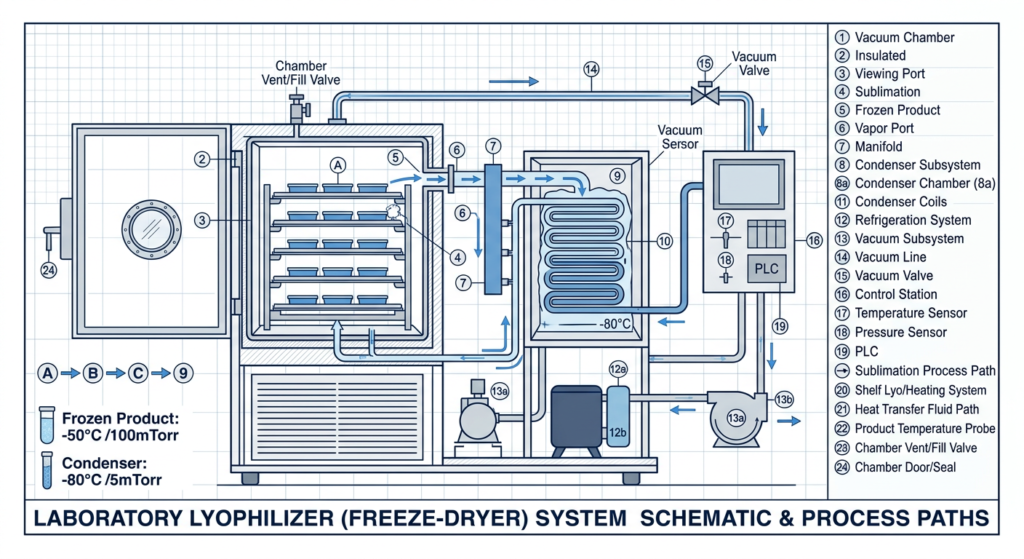
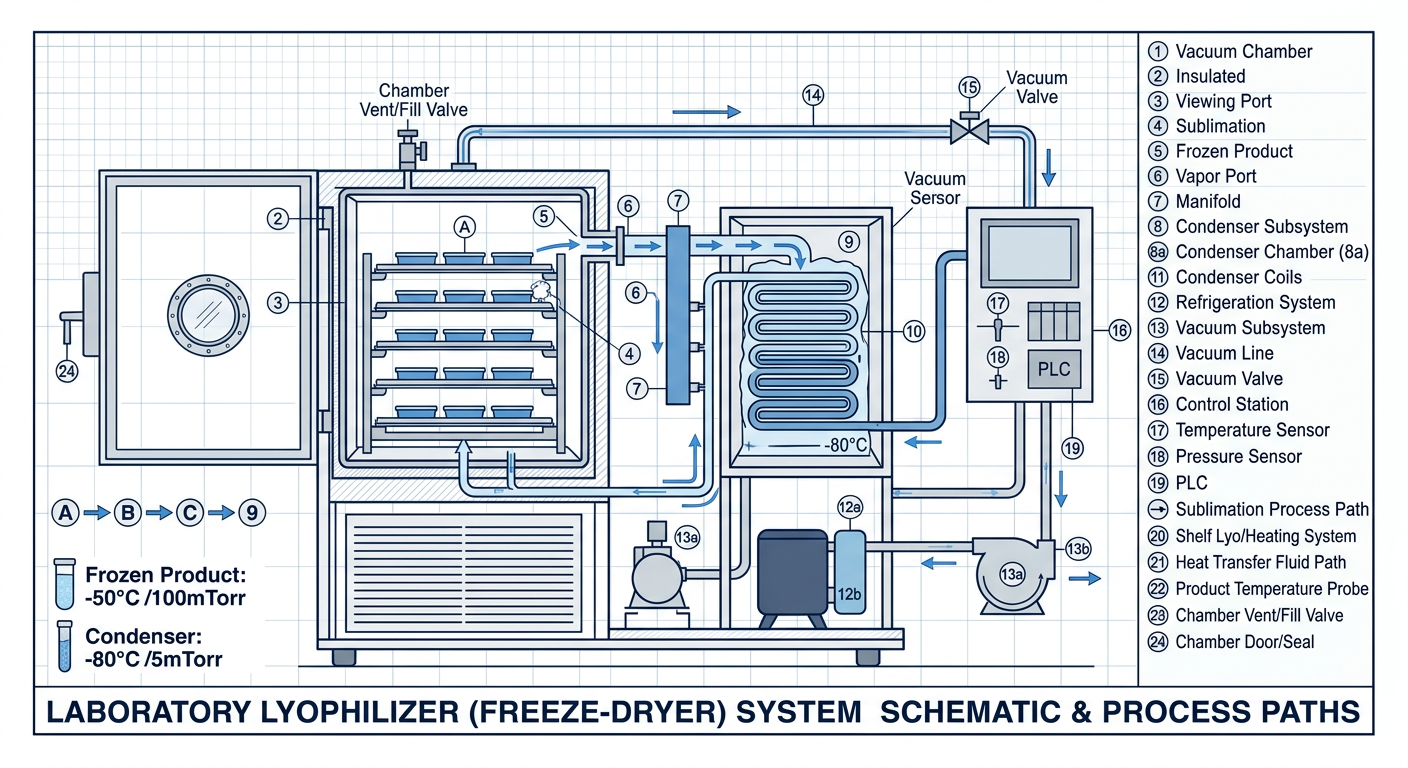
Once the product is completely thermally solidified (below $Tg’$ or $Te$), a high vacuum is forcefully pulled on the entire chamber, driving the environmental pressure radically low. In sophisticated laboratory freeze-dryers, the condenser coils function essentially as a powerful vapor trap. These coils are chilled to extreme negative temperatures (often $-50^circ$C to $-105^circ$C).
Sublimation is a highly endothermic process; it requires the continuous input of energy (heat of sublimation). Therefore, the shelves holding the frozen peptide vials are very carefully and incrementally heated. The driving force for moisture removal is not purely vacuum, but the thermodynamic pressure differential between the slightly warmed sublimating ice face within the vial and the intensely cold, extreme low-pressure surface of the condenser. The vapor instantly migrates away from the product block and rapidly desublimates (freezes back directly into solid ice) upon contact with the ultra-cold condenser coils.
During primary drying, it is an absolute necessity that the temperature of the frozen product matrix remains strictly below its critical collapse temperature ($Tc$, closely related to the $Tg’$). If heat is applied too rapidly, the frozen matrix may begin to micro-melt (collapse), resulting in a molten, un-dryable physical structure and massive damage to the peptide payload.
3. Secondary Drying (Isothermal Desorption)
Following primary drying, all macroscopic ice crystals have sublimed, leaving behind a porous, dry-appearing “cake.” However, significant amounts of tightly bound, non-freezing intermolecular water deeply integrated within the hydrogen-bonding structures of the peptide and the excipient matrix still remain (up to $5-10%$ residual moisture).
Secondary drying focuses on removing this persistent bound moisture through isothermal desorption. Because the protective ice matrix is now entirely gone, the product vacuum is maximized, and shelf temperatures can be gradually escalated significantly higher than during primary drying (often up to $+20^circ$C or $+30^circ$C). The goal is to aggressively bake out the remaining water molecules trapped within the complex molecular folds without triggering excessive thermal degradation in the now-dry peptide. The optimal residual moisture content for most lyophilized biologicals is remarkably low, typically optimized under $1%$ to $2%$, ensuring maximal long-term physical stability.
Formulation Chemistry: Protecting the Peptide
The extreme stresses of freezing and severe desiccation inherently threaten complex protein structures. Therefore, highly specialized chemical formulations are necessitated prior to running the lyophilization cycle.
- Buffering Agents: Strict pH control is vital to prevent acid/base catalyzed hydrolysis during the intense freeze-concentration phase.
- Bulking Agents (e.g., Mannitol): Often added to provide structural mass and crystalline stability to very dilute, high-potency peptide solutions, ensuring the formation of a robust, cosmetically elegant physical “cake” that resists crumbling.
- Lyoprotectants (e.g., Trehalose, Sucrose): These non-reducing disaccharides are critical for complex, heavily folded peptides. They function via the “water replacement hypothesis,” actively forming protective hydrogen bonds with the peptide’s surface as water is aggressively removed, artificially maintaining the molecule’s protective native conformation in a highly dehydrated state and preventing irreversible aggregation upon later reconstitution.
Conclusion
Lyophilization is a sophisticated and rigorous application of multi-phase physical chemistry thermodynamics. It is not merely cold-drying; it requires precise manipulation of critical glass transition temperatures, strict vacuum differentials, and complex sublimation kinetics. When correctly optimized alongside dedicated cryoprotectant formulation chemistry, lyophilization provides the unparalleled structural stability required to maintain intricate synthetic peptides for extensive advanced in-vitro research and pharmacological evaluation.