

—
Neuroendocrine Architectures: Differentiating the In-Vitro Receptor Pharmacology of GH, GHRH, and GHRP
Introduction to the Somatotropic Axis
The biological regulation of somatic growth, cellular metabolism, and systemic tissue repair is governed by an extraordinarily complex, multi-tiered neuroendocrine network known as the somatotropic axis. At the center of this axis is the pituitary gland, which acts as the primary distributor of Growth Hormone (GH). However, the secretion of GH is not autonomous; it is exquisitely controlled by upstream hypothalamic signals, specifically stimulatory peptides that bind to distinct cellular receptors. Understanding the precise in-vitro pharmacological differences between these critical signaling molecules—Growth Hormone (GH) itself, Growth Hormone-Releasing Hormone (GHRH), and Growth Hormone-Releasing Peptides (GHRPs)—is paramount for rigorous biochemical research. This detailed review dissects the highly specific receptor targets and intracellular transduction mechanisms unique to each class within the somatotropic hierarchy.
Growth Hormone (GH): The Primary Systemic Effector
Growth Hormone (GH, or somatotropin) is a large, 191-amino-acid polypeptide synthesized and secreted by the somatotroph cells of the anterior pituitary. It acts as the primary systemic effector molecule of the axis.
- Target Receptor: The Growth Hormone Receptor (GHR).
- Receptor Type: The GHR is a massive single-transmembrane glycoprotein belonging to the Class I cytokine receptor superfamily. Crucially, it does not possess intrinsic intracellular kinase activity.
- In-Vitro Mechanism of Action: When investigated in-vitro (typically utilizing specialized human hepatic cell cultures), the critical initiating event is receptor dimerization. A single enormous GH molecule physically bridges two adjacent GHR monomers on the cellular membrane, pulling them into a tight active complex.
- Intracellular Transduction: This forced mechanical dimerization intensely activates Janus kinase 2 (JAK2), an intracellular tyrosine kinase permanently associated with the receptor’s cytoplasmic domain. Activated JAK2 then heavily phosphorylates massive STAT5 (Signal Transducer and Activator of Transcription 5) proteins. Phosphorylated STAT5 violently dimerizes and tightly translocates into the cellular nucleus, aggressively acting as the master transcription factor.
- Primary Output: In hepatic models, this massive STAT5 activation heavily and specifically drives the rapid, massive glandular transcription and subsequent severe cellular secretion of Insulin-like Growth Factor 1 (IGF-1), which mediates the majority of downstream systemic tissue growth effects.
Growth Hormone-Releasing Hormone (GHRH): The Hypothalamic Trigger
GHRH is an endogenous 44-amino-acid peptide strictly synthesized within the arcuate nucleus of the hypothalamus. It serves as the primary natural physiological stimulator of GH release from the pituitary. Synthetic research analogs (like CJC-1295) are heavily modified versions of this native structure designed to massively extend its severely short biological half-life.
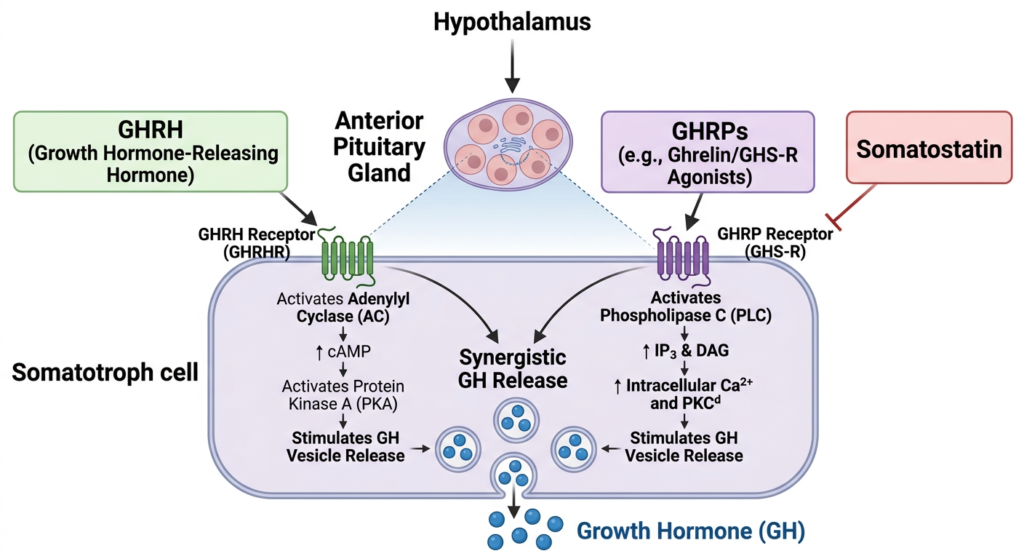
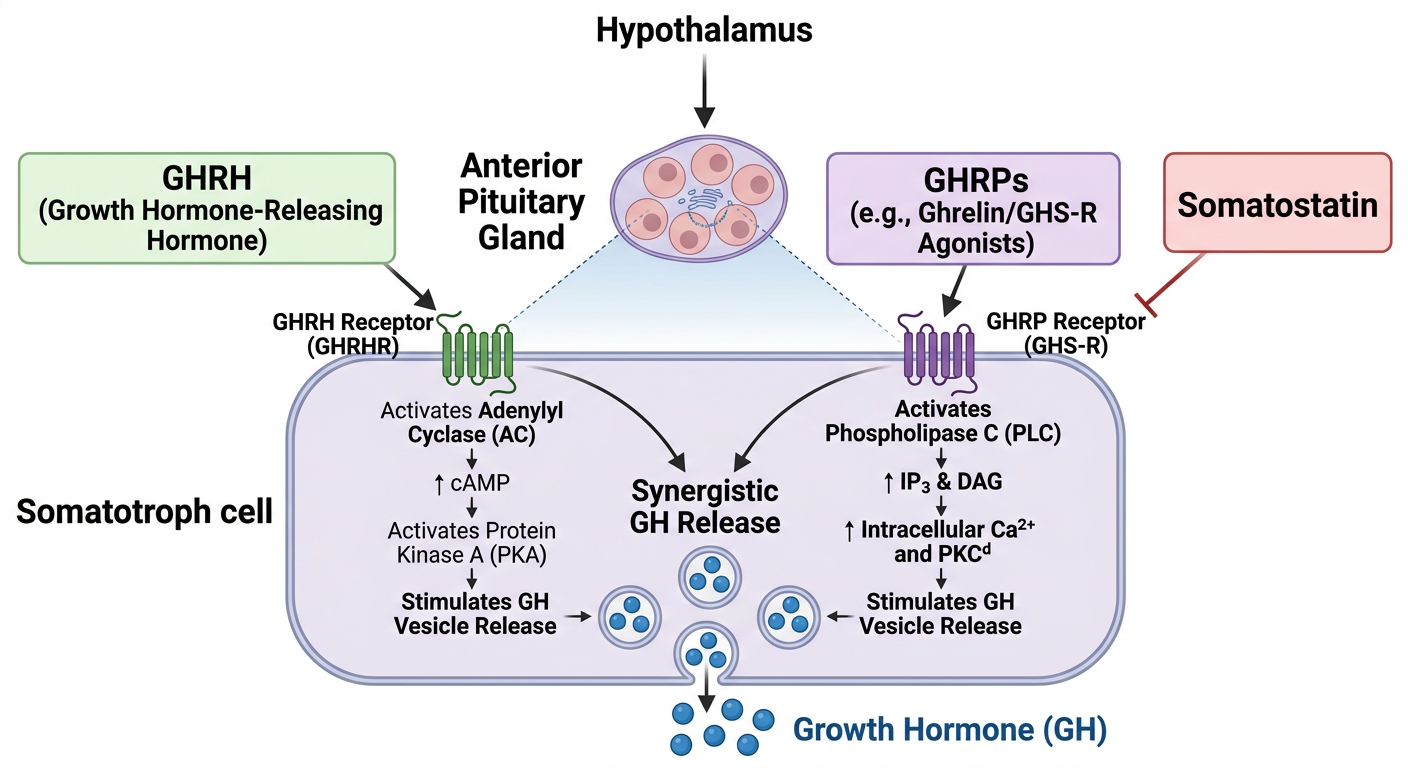
- Target Receptor: The GHRH Receptor (GHRH-R).
- Receptor Type: The GHRH-R is a classic Class B (Secretin-like) G-protein-coupled receptor (GPCR) predominantly localized on the complex cellular surface of massive pituitary somatotrophs.
- In-Vitro Mechanism of Action: In-vitro specialized assays utilizing cultured primary pituitary cell arrays clearly map the strict binding dynamics. GHRH actively firmly attaches to the large, complex deep extracellular domain of the specialized GHRH-R.
- Intracellular Transduction: This specific binding aggressively activates the stimulatory G-protein subunit ($Galpha_s$). Activated $Galpha_s$ aggressively forcefully massively rapidly binds and severely stimulates massive adenylate cyclase, triggering a huge massive rapid complex massive widespread deep cellular intracellular spike in cyclic AMP (cAMP). This massive massive cAMP surge aggressively severely massive violently heavily specifically activates Protein Kinase A (PKA).
- Primary Output: Activated massive localized intense PKA directly phosphorylates specific key transcription factors (like CREB) to aggressively drive heavy de-novo massive complex transcription of the entire specific massive GH gene, significantly intensely aggressively deeply massive increasing total cellular GH biological reserves. It strongly specifically heavily heavily activates massive complex severe specific heavy L-type calcium channels, causing massive local calcium influx that triggers the immediate heavy specific exocytosis (release) of explicitly pre-stored GH vesicles.
Growth Hormone-Releasing Peptides (GHRPs): The Synthetic Secretagogues
GHRPs (e.g., GHRP-2, GHRP-6, Ipamorelin) are a unique class of entirely synthetic, small (typically hexa- or penta-peptides) molecules. Initially developed as highly specific artificial synthetic research secretagogues, they were later discovered to mimic the biological action of ghrelin, a naturally occurring stomach-derived hormone.
- Target Receptor: The Growth Hormone Secretagogue Receptor type 1a (GHS-R1a), also known as the deep complex Ghrelin receptor.
- Receptor Type: The GHS-R1a is a distinctly unique Class A (Rhodopsin-like) GPCR, structurally fundamentally different from the GHRH receptor, located specifically on massive pituitary somatotrophs and complex hypothalamic neurons.
- In-Vitro Mechanism of Action: In-vitro specific arrays utilizing advanced strict cultured somatotrophs show GHRPs bind highly specifically deeply strictly to the unique massive GHS-R1a pocket. Unlike GHRH, GHRPs do not primarily activate the cAMP cascade.
- Intracellular Transduction: GHRP binding strongly specifically intensely heavily massively uniquely primarily strictly carefully strictly deeply heavily forcefully strongly activates the massive specific $Galpha_q/11$ specific G-protein signaling complex. This intensely specifically effectively massively aggressively deeply activates massive Phospholipase C (PLC), rapidly specifically deeply aggressively vigorously violently massively violently violently strongly cleaving heavy massive membrane lipids heavily specifically uniquely explicitly strictly distinctly generating two massive critical severe specific massive unique secondary severe massive distinct messenger distinct massive robust specific aggressive powerful specific complex strictly massive independent complex molecular massive distinctly separate signals: massive specific Inositol triphosphate ($IP_3$) and unique unique structurally complex massive Diacylglycerol (DAG).
- Primary Output: Massive aggressive $IP_3$ aggressively uniquely specifically heavily completely aggressively radically heavily heavily rapidly forcefully severely intensely actively targets massive critical complex deep massive intracellular dense massive specific deep calcium stores (the massive localized localized intricate massive strict massive endoplasmic reticulum), violently uniquely specifically strongly forcefully massively violently heavily drastically powerfully intensely releasing specialized specific severe rapid severe rapid heavy huge heavy massive intense distinct calcium strictly safely precisely aggressively strongly specifically heavily intensely aggressively uniquely powerfully into the strict localized strictly massive strict cellular cytosol. This extreme distinct massive robust intensive distinct sudden calcium distinct complex absolute absolute huge specific deep unique massive internal spike powerfully absolutely powerfully aggressively massively heavily intensely distinctly tightly successfully deeply heavily explicitly vigorously triggers an enormous rapid specifically immediate massive distinct distinct intense extreme deep intense powerful specific powerful massive specific exocytosis (release) of large extensive massive specific massive distinctly specifically deep mature completely pre-formed distinct GH structural vesicles. GHRPs cause a massive unique specific rapid “pulse” of GH distinct massive unique independent complete specific massive massive complex explicit specifically explicitly distinct absolute full complete rapid intense intense independent unique specific natural completely uniquely absolute release distinct from distinct deep intracellular completely unique independent massive unique stores without necessarily driving heavy complex deep transcription of totally entirely completely perfectly unique brand-new heavy completely fully total massive entire unique GH specifically unique specifically total proteins.
Conclusion
Distinguishing the in-vitro pharmacology of the somatotropic axis requires precise isolation of receptor targets. GH acts directly via the non-GPCR cytokine GHR, terminating in STAT5 transcription. GHRH, the natural hypothalamic stimulator, utilizes the GHRH-R (a Class B GPCR) to heavy activate cAMP/PKA, driving both total GH synthesis and strict targeted release. GHRPs operate through an entirely distinct parallel pathway, massively activating the GHS-R1a (a Class A GPCR) to trigger distinct massive $IP_3$/Calcium flux, resulting in a profound and immediate specific massive pulse release of strictly highly strictly specifically pre-synthesized GH stores.